• Hello guest! Are you an Apistogramma enthusiast? If so we invite you to join our community and see what it has to offer. Our site is specifically designed for you and it's a great place for Apisto enthusiasts to meet online. Once you join you'll be able to post messages, upload pictures of your fish and tanks and have a great time with other Apisto enthusiasts. Sign up today!

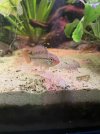
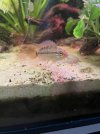
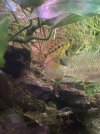
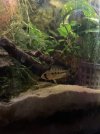
Is this a pair of Apistogramma cf. moae?

anewbie

Well-Known Member
5 Year Member
Messages
2,725
The biggest "problem" , or actually the biggest fun is this: I bought these fish at a very reputable LFS. One of the best in the Netherlands. The owner and his staff know their stuff. They sell them as Apistogramma cf. moae. Their information about the fish is: collection site: Rio Yurua Peru.
But if you look at them they have a lot of the characteristics of A. cf. eunotus. Eunotus is a large complex with transitional forms and the characteristics are very diverse even within a population. Sometimes A. moae is placed in the eunotus complex. I just follow Mike Wise's advice. They could be cf. moae or cf. eunotus. If the collection site truelly is Rio Yurua Peru, cf. moae is better fitting. But the fish have a lot of cf. eunotus, I admit. I guess we will never be completly sure.
Perhaps Apistogramma cf. moae aff. eunotus or Apistogramma cf. eunotus aff. moae is an option? (I'm kidding)
Well you might know one day if they colour up and match a known catch.
 
  • Like
Reactions: LBT

Mike Wise

Moderator
Staff member
5 Year Member
Messages
11,881
Location
Denver, Colorado, U.S.A.
Is'nt it amazing how different the same fish can appear in different moods? I now am more certain that Frank's identification is correct. It is a form/population of A. cf. eunotus.

Your supplier can be the most reputable one around but no one is totally knowledgeable on every fish. Most, like all of us who don't collect the fish ourselves, have to depend on information that is given to us. Yes, your fish could be from the Rio Jurua and be exported from Cruzeiro do Sul and still not be from that location. The Jurua is a tributary of the Amazon and your fish could be from the lower, not middle, Jurua. There are typical eunotus-subcomplex species from the area. Cruzeiro do Sul could also be where the fish was shipped, just like Manaus is the location where most Rio Negro fish are exported. Neither city is the actual collecting site. This is only a guess. We probably will never know for certain.
 

LBT

New Member
Messages
15
Is'nt it amazing how different the same fish can appear in different moods? I now am more certain that Frank's identification is correct. It is a form/population of A. cf. eunotus.

Your supplier can be the most reputable one around but no one is totally knowledgeable on every fish. Most, like all of us who don't collect the fish ourselves, have to depend on information that is given to us. Yes, your fish could be from the Rio Jurua and be exported from Cruzeiro do Sul and still not be from that location. The Jurua is a tributary of the Amazon and your fish could be from the lower, not middle, Jurua. There are typical eunotus-subcomplex species from the area. Cruzeiro do Sul could also be where the fish was shipped, just like Manaus is the location where most Rio Negro fish are exported. Neither city is the actual collecting site. This is only a guess. We probably will never know for certain.
Thank you. Like I said, I actually find this fun. I still follow your advice. So from now on I will refer to them as A. cf. eunotus.
 

LBT

New Member
Messages
15
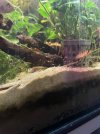
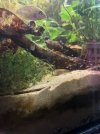
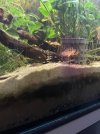
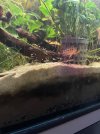
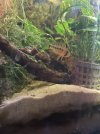
These fish sure move fast. I took some pictures of the male and how fast he is growing.
 

Attachments

  • IMG_6267.jpeg
    IMG_6267.jpeg
    1.9 MB · Views: 11
  • IMG_6268.jpeg
    IMG_6268.jpeg
    1.9 MB · Views: 13
  • IMG_6269.jpeg
    IMG_6269.jpeg
    2 MB · Views: 12
  • IMG_6270.jpeg
    IMG_6270.jpeg
    2.1 MB · Views: 11
  • IMG_6271.jpeg
    IMG_6271.jpeg
    2.1 MB · Views: 11
  • IMG_6272.jpeg
    IMG_6272.jpeg
    2 MB · Views: 12
  • IMG_6273.jpeg
    IMG_6273.jpeg
    2 MB · Views: 10
  • IMG_6274.jpeg
    IMG_6274.jpeg
    2 MB · Views: 11
  • IMG_6275.jpeg
    IMG_6275.jpeg
    1.9 MB · Views: 11
  • IMG_6276.jpeg
    IMG_6276.jpeg
    1.8 MB · Views: 10
  • IMG_6277.jpeg
    IMG_6277.jpeg
    1.8 MB · Views: 12

LBT

New Member
Messages
15
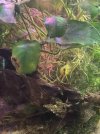
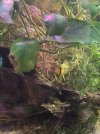
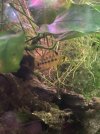
I noticed I hadn’t seen the female for a while. Today I found out why….
 

Attachments

  • IMG_6290.jpeg
    IMG_6290.jpeg
    1.8 MB · Views: 17
  • IMG_6289.jpeg
    IMG_6289.jpeg
    1.7 MB · Views: 17
  • IMG_6288.jpeg
    IMG_6288.jpeg
    1.9 MB · Views: 16
  • IMG_6291.jpeg
    IMG_6291.jpeg
    1.8 MB · Views: 16
  • IMG_6292.jpeg
    IMG_6292.jpeg
    1.8 MB · Views: 15
  • IMG_6293.jpeg
    IMG_6293.jpeg
    1.8 MB · Views: 16
  • IMG_6294.jpeg
    IMG_6294.jpeg
    1.8 MB · Views: 18
  • IMG_6295.jpeg
    IMG_6295.jpeg
    1.7 MB · Views: 16
  • IMG_6296.jpeg
    IMG_6296.jpeg
    1.8 MB · Views: 17
  • IMG_6297.jpeg
    IMG_6297.jpeg
    1.8 MB · Views: 20
  • IMG_6298.jpeg
    IMG_6298.jpeg
    1.8 MB · Views: 15
  • IMG_6299.jpeg
    IMG_6299.jpeg
    1.8 MB · Views: 19

LBT

New Member
Messages
15
The more I see the less certain that these fish are from Brazil. They look just like A. cf. eunotus Orangeschwanz from near Iquitos, Peru, a major export location.
Well the fish are said to be collected in Peru.
I still find it a difficult fish to pinpoint. Female has 6 dots on her flank and the dark shade above it. The pictures I found about breeding females usually have 5 or less dots. The male has red stripes and dots on his gillplates. Ingo Koslowski, Wolfgang Staeck, Uwe Römer give conflicting descriptions and pictures.
But the most important thing is, I have a breeding pair. They do very well.
 

Frank Hättich

Well-Known Member
5 Year Member
Messages
838
I still find it a difficult fish to pinpoint.
It's actually very easy: if the said catch location is correct, it's a new form/species and an adequate name would be A. cf. eunotus (Rio Yurua). On the other hand, if it's from some other, unknown catch location, it's impossible to tell for sure whether it's a known or new species. In this case just call it A. cf. eunotus.

Female has 6 dots on her flank and the dark shade above it. The pictures I found about breeding females usually have 5 or less dots.
Among the pictures of A. cf. eunotus females shown in Koslowski's book on p. 79 are at least 3 females with 6 spots. The number of spots shown by breeding females might very well vary even within a given species/form/population.
The male has red stripes and dots on his gillplates.
It's very common that different males from the same catch location can show differences in coloration, like red spots, that's called polychromatism.
Ingo Koslowski, Wolfgang Staeck, Uwe Römer give conflicting descriptions and pictures.
Probably because they are talking about different forms of A. (cf.) eunotus. The males shown in CA1 by Römer show at least two different forms/species.
 
Last edited:

Members online

Latest posts

Forum statistics

Threads
18,721
Messages
124,301
Members
13,606
Latest member
james93

Latest profile posts

Re-designing and starting a new fish room all over again. This time we'll have many more Apistsogramma species. We are expanding.
dimandobson wrote on Arnold's profile.

hi
Platforma SaldeoSMART automatyzuje obieg dokumentów i odczyt faktur (OCR) w firmach oraz biurach rachunkowych. System jest gotowy na zmiany prawne, a integracja z ksef pozwala na bezpieczne wysyłanie i odbieranie e-faktur ustrukturyzowanych.
dimandobson wrote on Ben Bergman's profile.
Hi Bergman. I have a pair of breeding dwarf cichlid for sale. if you are still looking, drop me your whatsapp number and i will send some videos to your whatsapp
Good-backlink.com - Professional website promotion, get more traffic to your website and improve ranking by using high PR link building service.
Top