This is what I was missing. Thank you!but when you have carbonate buffering some of that buffering is in solution as bicarbonate (HCO3-) or carbonate (CO3--), meaning that you have more Total (or Dissolved) Inorganic Carbon T(D)IC.
It depends, not all plants can use bicarbonate (HCO3-) as their DIC source. Plants that naturally occur in acidic water may not have the enzymes required.So if i understand correctly - in the end it doesn't have more co2 per sey but it has more carbon which is the important piece of information as that is what allows the plants to grow better.


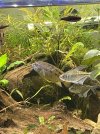
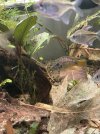
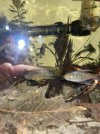
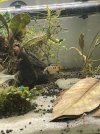
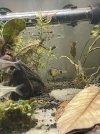
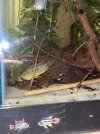
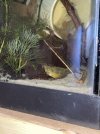
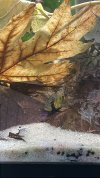
I have seen this a lot when my dwarfs foraged through the tank, getting detritus particles on their bodies.I did notice that the male has recently been exhibiting some weird thrashing behaviour, almost like he’s trying to scratch an itch. Every now and then he’ll stop in his tracks and thrash about, almost crashing into hardscape and plants before going back to idling. Any ideas?
I don't see any irregular black spots i the pictures. Care to elaborate?Perhaps it’s related to the black spots? They’ve begun to appear on both the male and the female, and after some research I assuming it’s one of those relatively harmless multi-species parasites that travel onto bird. Is it possible that they may cause itching and general discomfort on the fish? I don’t think it’s because of an injury or infectuon as otherwise the fish looks great.
The spots show up much clearer on the female. In older images you can see that the forehead is simply darker and is otherwise clear of markings.I have seen this a lot when my dwarfs foraged through the tank, getting detritus particles on their bodies.
I don't see any irregular black spots i the pictures. Care to elaborate?


I've used the Ultralife blue green slime remover stuff with over 50-60+ 1 week old fry, multiple times. I had no related losses. In other tanks, I haven't experienced a single loss to fish or shrimp with the product either. It is suspected to be an enzymatic villain to cyanobacteria. My cyano disappears in 48 hours and I follow up with a 50% WC. It always returns, but can take weeks/months if you are diligent about keeping water lean and aggressive with cleaning organics.Trust me. I have been trying my best while avoiding using chemicals. I added ramshorn snails last week and I’ve been removing as much as I can every other day to no avail.
Next time I clean the filter I’ll add some dried Cyanobacteria there, as I heard that does something. Why? No idea but it’s worth a shot.
It thrives on dying algae and plants, but will coat high light areas and draw water bound organics anywhere. High flow does not make an appreciable difference despite what's said online.Have you any idea what causes the Cyanobacteria?
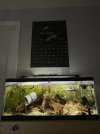
Do you have other tanks? Are they the same?