• Hello guest! Are you an Apistogramma enthusiast? If so we invite you to join our community and see what it has to offer. Our site is specifically designed for you and it's a great place for Apisto enthusiasts to meet online. Once you join you'll be able to post messages, upload pictures of your fish and tanks and have a great time with other Apisto enthusiasts. Sign up today!

Wild caught A. Ortegai shyness and hiding

TacocaT

New Member
Messages
25
Location
Canada
Your assessment appears to be true. I just witnessed the female pop out of her hide hole and absolutely maul the rubber lip pleco that happened to be around.
 

Ben Rhau

Apisto Club
5 Year Member
Messages
699
Location
San Francisco
Don’t do it right now (and stress out the female) but I would take the pleco out if you want them to breed. See how this clutch goes first. If it eats the fry, no big deal this time. The apistos will keep breeding.
 

Ben Rhau

Apisto Club
5 Year Member
Messages
699
Location
San Francisco
Also, if the fry survive beyond like a week or so, I would consider removing the male also. The pair will just keep breeding, which is energetically expensive for the female. Gives her some time to recover.
 

TacocaT

New Member
Messages
25
Location
Canada
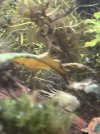
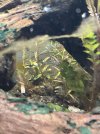
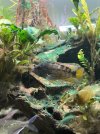
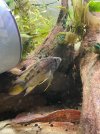
I have a theory, which is that I’m terrifying the male in particular. I don’t think there’s anything physically wrong, as I’ve seen him dancing and occasionally foraging, but he’s always hiding when I show up and doesn’t accept food from my tweezers anymore. Also I was watching him do the dance with the female and then the moment he saw me he ran back to this spot here.

Is there anything I should do to make him more comfortable with me?
image.jpgimage.jpg
 

Ben Rhau

Apisto Club
5 Year Member
Messages
699
Location
San Francisco
It depends. Some fish are just always jumpy when there's movement in front of the tank, and in that case it helps not to have movement from above... Approach the tank lower and possibly when the tank is lit and the room isn't.

That said,
  1. You said he doesn't accept food from tweezers *anymore*, which implies that he used to not be so shy around you.
  2. The apistos I've had were always VERY interested in food when they see me approach the tank, unless it's a female guarding eggs, in which case they still want to come out, but more cautiously.
My guess is that the male is stressed out generally, possibly because he wants to breed with the female, and she's chasing him away (viciously) from the eggs. Try to make sure he's eating. Maybe it's dropping food in a place where he can see it and access the food away from your tweezers. If he doesn't perk up in a few days, you could consider separating him. Depends on his behavior, coloration, etc.

I’ve seen him dancing and occasionally foraging
What do you mean by "dancing"?
 

anewbie

Well-Known Member
5 Year Member
Messages
2,702
I have a theory, which is that I’m terrifying the male in particular. I don’t think there’s anything physically wrong, as I’ve seen him dancing and occasionally foraging, but he’s always hiding when I show up and doesn’t accept food from my tweezers anymore. Also I was watching him do the dance with the female and then the moment he saw me he ran back to this spot here.

Is there anything I should do to make him more comfortable with me?
View attachment 17175View attachment 17176
After two years my a. wolli will have nothing to do with me - this was the case from day 1. They remain very shy and reclusive. @Mike Wise indicate this is not the case for him. I did have two f1s that are marginally more open but still very reclusive. On the bright side it looks like i might have a nice f1 male that can actually swim. I say might because i only got a glimpse of his tail but it seems to be starting to form a lyre tail.

One of my male a. ladisalo is also very reclusive again for 2 years - the other one (in another aquarium) never bothers to hide so I don't think it is species specific per sey.

I've not seen anything specific that explains the behavior (light level, floating plants, ....).
 

Ben Rhau

Apisto Club
5 Year Member
Messages
699
Location
San Francisco
Another situation that fish are shy is when there is food available in the tank independent of you (like live foods growing, or from foraging). If they get to eat plenty way, they're not dependent on that small window of time when you feed them. I know folks who keep elassoma this way, with worms living in the substrate.

The disadvantage of keeping fish this way is that you don't see them as much: The hide when they see you. The advantage is you can see more of their natural behavior if you can observe them when they *can't* see you.

I like it when the fish are excited to see me, but I admit I don't get to see what they're really like when I'm not around,
 

TacocaT

New Member
Messages
25
Location
Canada
It depends. Some fish are just always jumpy when there's movement in front of the tank, and in that case it helps not to have movement from above... Approach the tank lower and possibly when the tank is lit and the room isn't.

That said,
  1. You said he doesn't accept food from tweezers *anymore*, which implies that he used to not be so shy around you.
  2. The apistos I've had were always VERY interested in food when they see me approach the tank, unless it's a female guarding eggs, in which case they still want to come out, but more cautiously.
My guess is that the male is stressed out generally, possibly because he wants to breed with the female, and she's chasing him away (viciously) from the eggs. Try to make sure he's eating. Maybe it's dropping food in a place where he can see it and access the food away from your tweezers. If he doesn't perk up in a few days, you could consider separating him. Depends on his behavior, coloration, etc.


What do you mean by "dancing"?
By dancing I mean the mating ritual. Just today the female was hanging around a pit and despite my best efforts to see I didn't find any fry nor eggs, which is curious. The male did pop out once to display to the female, but once he saw me he scampered away.

I have occasionally spotted him move about the tank and pick at the ground, but the moment he sees me looking he darts back to the hiding spot and doesn't move for at least 15 minutes. Previously he would very readily go for the frozen brine shrimp and bloodworms, but now not even the bloodworms provokes any interest. If I try to bring them closer to his mouth he just backs away slowly. I'll keep an eye on him, but his colours are still quite washed out.

From now on I'll try feeding brine shrimp and bottom feeder sinking pellets mainly with bloodworms once every two weeks, and see if he perks up then.

I also fear that I'm too disruptive when I conduct maintenance, as I'm currently dealing with a cyanobacteria issue which requires my whole hand into the tank to manually remove it. I also often come home very late tired and turn on the big light, which may spook the fish. I'm going to see if I can make a curtain around the front of the tank so that there's less outside light that gets in during the tank's nighttime.

I will also mention I am very new to keeping Apistogramma. I have kept Bolivian rams before and got them to breed, but that is the extent of it.
 

TacocaT

New Member
Messages
25
Location
Canada
Some fish just learn to hide. Do you have any floating plants that could shade at least part of the tank? The tank look rather bright to me.
I have dwarf water lettuce that’s doing alright, but i did cull them a weeks ago so there a bit less than normal right now. I’ll try to get my hands on some frogbit or hydrocotyle but right now it’s midterm season so I’m a tad preoccupied.
 

Ben Rhau

Apisto Club
5 Year Member
Messages
699
Location
San Francisco
I’m my experience, Salvinia are pretty useful for cover. Very easy to keep alive, shades well and grows fast. I tend to keep about 2/3 of the surface covered with floaters. Frogbit is also good. I like hydrocotle but it won’t provide broad cover since it’s more of a stem plant.
 

anewbie

Well-Known Member
5 Year Member
Messages
2,702
My personal favorite is frogbit.... just be aware that no floater is going to do well in current.
 

TacocaT

New Member
Messages
25
Location
Canada
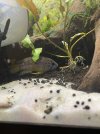
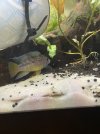
So the male has finally been coming out more, and him and the female appear to be on good terms, as I don’t see either of them going after each other.

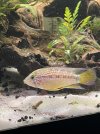
I would like to just confirm that these are apistogramma Ortegai “papagayo” and are the same species, as through reading the forums I’ve noticed shops often mislabel their fish.

IMG_3182.jpeg
IMG_3183.jpeg


Here’s some older pics from when they were more coloured up:

IMG_2972.jpegIMG_2971.jpegIMG_2773.jpeg
 
Last edited:

Mike Wise

Moderator
Staff member
5 Year Member
Messages
11,869
Location
Denver, Colorado, U.S.A.
The female is definitely confusing. It has a caudal patch more like that seen on A. cf. orgetai (Pebas). Holotype A. ortegai females will only show 2 prominent flank spots (on Bars 3 & 4) when brooding or dominant. In neutral mood females of A. ortegai show 4 - 5 lateral spots with the 2 spots on Bars 3 & 4 more prominent. Your female shows 2 prominent spots but also a spot on Bar 2; odd.

I suggest that you accept it as a slightly abberant female A. ortegai. In domestic bred fish variations tend to increase without careful breeding. In wildcaught fish at present I doubt that you can get A. ortegai from the middle Rio Ampiyacu, but get specimens released near Pebas where they are mixed/crossbred with A. cf. ortegai (Pebas).
 

TacocaT

New Member
Messages
25
Location
Canada
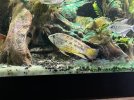
Small update, the male has become a lot more outgoing and is accepting food from my tweezers again, which is a good sign. His colours are still not as vibrant as when he first arrived, while the female has only gotten more colourful. Could it be that the male is simply old? If the fish was in a display tank at the store and is already this big, perhaps it’s just aging? Asking here for a second opinion.

IMG_3306.jpegIMG_3296.jpegIMG_3266.jpeg
 

TacocaT

New Member
Messages
25
Location
Canada
It's for sure a fish in his prime or just beyond it.

But besides... you should do something about the cyanobacteria.
Trust me. I have been trying my best while avoiding using chemicals. I added ramshorn snails last week and I’ve been removing as much as I can every other day to no avail.

Next time I clean the filter I’ll add some dried Cyanobacteria there, as I heard that does something. Why? No idea but it’s worth a shot.
 

anewbie

Well-Known Member
5 Year Member
Messages
2,702
I've used chemi-clean (I know you are avoiding chemicals) without ill effect. Or if it had ill effect the dwarf cichild (I think it was a. nijjensi) still lived over 4 years.
 

KenL

Active Member
5 Year Member
Messages
298
Have you any idea what causes the Cyanobacteria?
Do you have other tanks? Are they the same?
 

Members online

No members online now.

Forum statistics

Threads
18,703
Messages
124,172
Members
13,589
Latest member
rozyjuise

Latest profile posts

Platforma SaldeoSMART automatyzuje obieg dokumentów i odczyt faktur (OCR) w firmach oraz biurach rachunkowych. System jest gotowy na zmiany prawne, a integracja z ksef pozwala na bezpieczne wysyłanie i odbieranie e-faktur ustrukturyzowanych.
dimandobson wrote on Ben Bergman's profile.
Hi Bergman. I have a pair of breeding dwarf cichlid for sale. if you are still looking, drop me your whatsapp number and i will send some videos to your whatsapp
Good-backlink.com - Professional website promotion, get more traffic to your website and improve ranking by using high PR link building service.
martin_c wrote on illumnae's profile.
Hi,

just in case you happen to live in Germany (or Netherlands): I have a wildcaught female A. psammophila, you could have it for free. I have no use for it anymore.

BR
Martin
Top