• Hello guest! Are you an Apistogramma enthusiast? If so we invite you to join our community and see what it has to offer. Our site is specifically designed for you and it's a great place for Apisto enthusiasts to meet online. Once you join you'll be able to post messages, upload pictures of your fish and tanks and have a great time with other Apisto enthusiasts. Sign up today!

Wild caught A. Ortegai shyness and hiding

TacocaT

New Member
Messages
25
Location
Canada
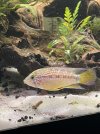
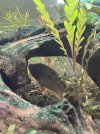
I've been keeping a pair of Apistogramma Ortegai for a month and a half now and over the past few weeks I've noticed a change in behaviour in the male, namely increased shyness, muted colours, and significantly less time spent moving around the tank. I'm doubtful this has to do with water chemistry or aggression, as none of the other fish have any problems and the female of the pair has become very outgoing and frequents all corners of the tank. Previously the male was much more active and he would swim about and even do the mating dance in the open area.
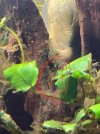
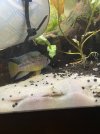
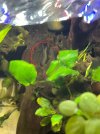
I'm mainly asking this because most recently I found him wedged face first in a hollow in a wood piece, as seen in the following images:
IMG_3116.jpgIMG_3117.jpg
I've also seen him hang motionless in this location for hours at a time while not even interacting with the other inhabitants in the tank.
IMG_3115.jpg


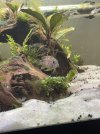
Images from the beginning:
IMG_2973.jpgIMG_2971.jpgIMG_2773.jpg

The tank is a 20g long with substrate mix of fluval stratum, ADA amazonia and pool filter sand. pH is 7.2 and there is plenty of wood and dead leaves for tannins. Temp is about 24°C and light is on for 8 hours a day.
Other inhabitants include 6 diamond tetras, 1 female Ortegai, 1 Sturisomatichthys Leightoni, 1 Rubber lip pleco, and two amano shrimps.
All thoughts and opinions are appreciated greatly
 

TacocaT

New Member
Messages
25
Location
Canada
I should also note that this fish used to be in a display tank and the store owner mentioned that this fish was a particularly large specimen.
 

MacZ

Well-Known Member
5 Year Member
Messages
4,323
Location
Germany
Before I say anything: Care to share a picture of the whole tank?
 

KenL

Active Member
5 Year Member
Messages
298
Is there a lot of water movement?

It also looks very light. More cover and less light might help.
 

anewbie

Well-Known Member
5 Year Member
Messages
2,702
My wc ortegai did not hide much but they had plenty of hiding places. I suspsect your aquarium is too open making them feel uneasy.
 

TacocaT

New Member
Messages
25
Location
Canada
Is there a lot of water movement?

It also looks very light. More cover and less light might help.
Somewhat, I'm running the canister filter at full power but the strongest flow is near the top and throughout the rest of the tank it's only a tiny bit to keep the water moving, probably not too much for the fish but I'll try to turn it down a tad.

It's much darker in person, the phone overcompensates for the darker room. You might have a point with the cover though, should I perhaps get a lily plant or something for overhead cover?

My wc ortegai did not hide much but they had plenty of hiding places. I suspsect your aquarium is too open making them feel uneasy.
I'll see if I can get an old plant pot and place that somewhere private. I have noticed the catfish frequenting the spot with overhanging branches so maybe their old hideout got hijacked.
 

MacZ

Well-Known Member
5 Year Member
Messages
4,323
Location
Germany
I suspsect your aquarium is too open making them feel uneasy.
I would determine this to be the most obvious point. It doesn't matter if they were in a display at the shop before, if the tank offers barely any cover and has lots of open spaces these fish often will not properly settle in. The amount of open sand area is quite a lot. Even the tetras in the picture stay down and whereever there's some kind of cover.
The washed out colours are for sure due to this, as Cichlids try to adapt their colouration to their environment. Dark environment, dark base colouration, bright environment, bright and washed out colours.
Also for the female Apistogramma this might be a death trap, because she will be a sitting duck to the male whenever she leaves her cover. A situation often ending in the weaker individual avoiding feeding.

So what I would do: double to triple the amount of driftwood, add lots of leaf litter and floating plants. Also my best advice: Float some Hydrocotyle leucocephala (brazilian pennywort). The stuff is perfect for cover.

I might also add: Stress is the number 1 killer in captive Apistogramma. Their immune systems tend to fail under the pressure of stres hormons, which leads to a certain syndrome which kills off a lot of Apistos in conditions that don't fit their needs.
 

TacocaT

New Member
Messages
25
Location
Canada
I would determine this to be the most obvious point. It doesn't matter if they were in a display at the shop before, if the tank offers barely any cover and has lots of open spaces these fish often will not properly settle in. The amount of open sand area is quite a lot. Even the tetras in the picture stay down and whereever there's some kind of cover.
The washed out colours are for sure due to this, as Cichlids try to adapt their colouration to their environment. Dark environment, dark base colouration, bright environment, bright and washed out colours.
Also for the female Apistogramma this might be a death trap, because she will be a sitting duck to the male whenever she leaves her cover. A situation often ending in the weaker individual avoiding feeding.

So what I would do: double to triple the amount of driftwood, add lots of leaf litter and floating plants. Also my best advice: Float some Hydrocotyle leucocephala (brazilian pennywort). The stuff is perfect for cover.

I might also add: Stress is the number 1 killer in captive Apistogramma. Their immune systems tend to fail under the pressure of stres hormons, which leads to a certain syndrome which kills off a lot of Apistos in conditions that don't fit their needs.
I don’t have any extra driftwood on me right now but I rearranged a piece in the back to fill up the open area, and I added a crap ton more of aqua soil to darken up the back area. I also dumped in the rest of the leaves that I currently have along with the tannin stained water I got from boiling them.

IMG_3122.jpeg


I do fear the temporary dust freaked out the male because he’s now wedged in the back between the wood and some stem plants but I’ll update tomorrow and see if he’ll eat.
 

TacocaT

New Member
Messages
25
Location
Canada
I have also been wondering about the kind of food to feed the apistogramma in particular? I've noticed the male to be most interested in the bloodworms I fed once a week but I've stopped feeding those since I read about the health detriments. Otherwise I have been feeding the tank daily alternating between frozen spirulina brine shrimp and flakes/mini-pellets. I've only seen the apistos actively go for the artemia and the bloodworms and also nibble at the bottom-feeder wafers. However, since the male has gone into hiding I haven't really seen him come to eat at all and I'm just hoping that he'll pick at the bottom feeder wafers that I leave for the catfish.

Would I perhaps also be able to coax him out if I got some daphnia on hand?
 
Last edited:

MacZ

Well-Known Member
5 Year Member
Messages
4,323
Location
Germany
Firstly about the tank: Better. far from perfekt, but better. To make sure the Apistos won't get on each others throat you should use a piece of wood as a sight barrier. about 10-15cm above the sand, no way of looking (let alone swimming) through underneath it and if possible glass to glass.
I would also get more floaters. Like quadruple the amount.

Now about feeding: Bloodworms/red mosquito larvae are problematic. We have reports from all over the world of people losing their Apistogramma after feeding that stuff. The definitive reason is not cleared at the moment, but we have a good base of data telling us there is a connection. There are of course people that have not had any poblems with that, but those are a minority.

If you want to feed properly: Crustaceans and insects/insect larvae are best. Avoid bloodworms and dry foods with high amounts of grains, vegetables and fish meal. The natural mode of feeding is picking at biofilms and sifting sand for edible things like insect larvae and other microfauna. They eat a lot of detritus while doing so as well.
 

Mike Wise

Moderator
Staff member
5 Year Member
Messages
11,869
Location
Denver, Colorado, U.S.A.
Hmm. I thought that bloodworms were insect larvae of a chironomid midge? I am in the minority in that I occasionally feed bloodworms - but from a trusted manufacturer and a trusted retailer and I check the package for indications of partial thawing before purchase. I do the same for any frozen food for my fish and me! If you want to add to the fishes' diet, I recommend live baby brine shrimp.
 

Ben Rhau

Apisto Club
5 Year Member
Messages
699
Location
San Francisco
I'm also in the minority (for this group) that have not had problems with bloodworms. Similar to Mike, I only use a certain brand (Hikari) and only from a store whose owner I trust that will properly handle frozen products. He feeds them regularly to a lot of his own stock.

I'll echo that no one has definitively shown why bloodworms sometimes might cause problems. I always cut each frozen cube into very small pieces. I don't feed much, and only once a week or so. I do notice that most fish prefer this food over others. I understand why keepers would err on the side of caution, but I've not had bad experiences with this practice in 10+ years of feeding this variety of food.

Other foods:
  • Frozen artemia (esp omega or spirulina enriched). Not as much luck with other frozen foods.
  • Bug bites, the very small tropical granules.
  • Hikari micro pellets.
  • BBS are always very useful. Mildly inconvenient to continually hatch them in small quantities.
  • I keep my own blackworms to ensure cleanliness. But only feed in moderation.
  • Never had luck maintaining daphnia/moina. They always seem to crash for me.
  • Grindal worms are great, but I think it's impossible to avoid contamination from mites, and I find that inconvenient.
Between 2 varieties of frozen and 2 varieties of dry foods that they will accept, that mostly works for me. I hatch BBS when there are fry, and the adults eat some of that.
 

anewbie

Well-Known Member
5 Year Member
Messages
2,702
My stable food is ground up fluval bug bite so it is fairly small and sometime frozen shrimp of vious short (myst, brine) as well as occasionally live bbs. It depends on different factors - frys i want to raise i always feed bbs 2 to 4 times a day for first 3 weeks. Tidbit i never ever saw one of my fishes spawn and she managed to raise the frys just fine without any sort of special feeding.

I probably over feed my fishes but have cut down a lot the past year. As for worms - i only feed my discus freeze dried blackworms i don't bother with worms for anyone else - if i had the energy to raise black worms i'd feed some occasional live blackworm but i think i've reached the limit of what i can handle under the current situation.
 

dw1305

Well-Known Member
5 Year Member
Messages
2,980
Location
Wiltshire UK
Hi all,
Hmm. I thought that bloodworms were insect larvae of a chironomid midge?
They are, and I believe they are an important food items for wild Apistogramma. There are hundreds of species of chironomid, including some that occur in oligotrophic condition etc.
I am in the minority in that I occasionally feed bloodworms
I do as well.
- but from a trusted manufacturer and a trusted retailer and I check the package for indications of partial thawing before purchase.
I've been to a number of sewage treatment works, where you get "non-biting midges" (Chironomidae) in huge numbers, and I only feed bloodworms that I've <"ranched"> myself in clean water.

The problem is if you have enough bloodworms to be worth collecting commercially, the water was grossly organically polluted. Because they have tough exoskeletons the collection method is to scoop up a scoop of "mud" and wash the bloodworms out with a hose.

Cheers Darrel
 

TacocaT

New Member
Messages
25
Location
Canada
Hey all, so I bring a mildly concerning update: Ever since I redid the tank the pair have been interacting a lot more and I have seen them engage in "the dance" a couple times. However, I haven't seen the female at all since yesterday midday, and the male has not been in the hole in the log since around the same time. Is it part of A. ortegai spawning behaviour for the female to fully disappear and monitor the eggs without dad participation? I do have a small fear that she may be dead, only because I conducted a small water change and typically the kerfuffle leads the female to show her face, but not this time.
 

TacocaT

New Member
Messages
25
Location
Canada
Yes, it is completely normal for the female to want to stay with her eggs. This is a good sign, in my opinion.
Sorry just to clarify I don't know if she has eggs, I'm just speculating as I haven't seen her in a day and the male has been kicked out of his usual spot. Thanks for your confidence though!
 

Members online

Forum statistics

Threads
18,704
Messages
124,174
Members
13,590
Latest member
jukaklimatyzacje

Latest profile posts

Platforma SaldeoSMART automatyzuje obieg dokumentów i odczyt faktur (OCR) w firmach oraz biurach rachunkowych. System jest gotowy na zmiany prawne, a integracja z ksef pozwala na bezpieczne wysyłanie i odbieranie e-faktur ustrukturyzowanych.
dimandobson wrote on Ben Bergman's profile.
Hi Bergman. I have a pair of breeding dwarf cichlid for sale. if you are still looking, drop me your whatsapp number and i will send some videos to your whatsapp
Good-backlink.com - Professional website promotion, get more traffic to your website and improve ranking by using high PR link building service.
martin_c wrote on illumnae's profile.
Hi,

just in case you happen to live in Germany (or Netherlands): I have a wildcaught female A. psammophila, you could have it for free. I have no use for it anymore.

BR
Martin
Top