• Hello guest! Are you an Apistogramma enthusiast? If so we invite you to join our community and see what it has to offer. Our site is specifically designed for you and it's a great place for Apisto enthusiasts to meet online. Once you join you'll be able to post messages, upload pictures of your fish and tanks and have a great time with other Apisto enthusiasts. Sign up today!

Tank Size Confirmation Please :)

Glass Box Diaries

New Member
Messages
20
Hi everyone,

I’m hoping to get some confirmation on appropriate tank sizes for different types of Apistogramma, as I’m finding a lot of conflicting information online.

Below is a table showing the Apistogramma species available in my area, along with their suggested lengths and tank sizes according to Seriously Fish.

Are they accurate?
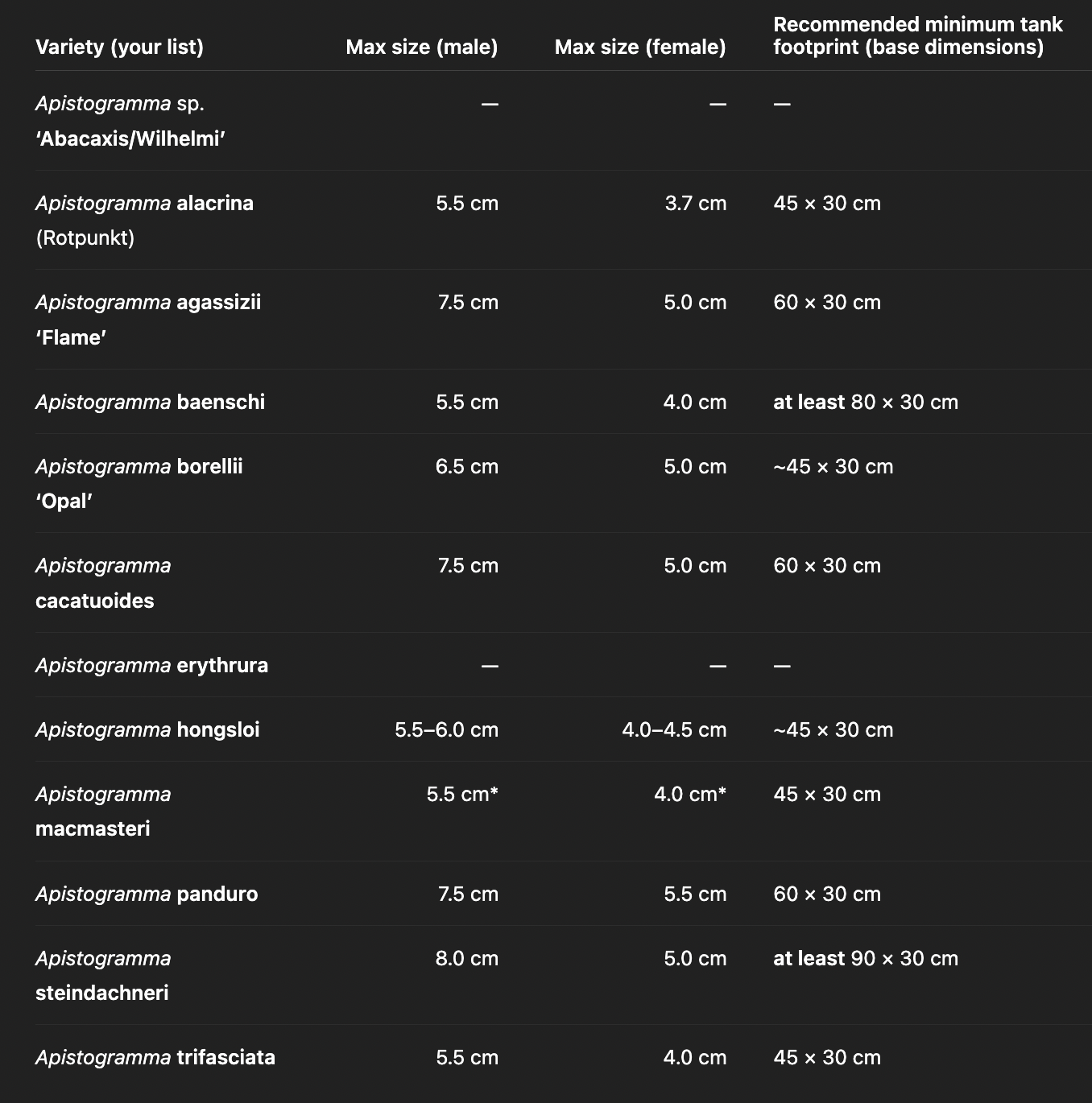
Screenshot 2026-02-02 at 13.26.06.png


I’m looking for recommendations on Apistogramma varieties that would do well in a 54-litre tank (60 × 30 × 30 cm). The tank will be heavily planted with broad-leaf plants like Anubias and Echinodorus, and the Apistogramma will be the only fish species in the setup.

My original plan was to keep a pair (1 male and 1 female), but I’ve seen mixed advice—some sources suggest the female can become stressed if the male is constantly breeding/chasing. Because of that, I’m also open to keeping a single male if that’s the better option.

I’m planning two separate 54-litre tanks.

At first I was leaning towards Apistogramma cacatuoides, but I’ve also read comments about potential genetic issues in some lines due to heavy inbreeding. With that in mind, I’ve been considering A. macmasteri, A. hongsloi, or A. trifasciata instead.

Any suggestions would be appreciated.

The photo below shows the kind of planting style I’m aiming for—this example is from my 160-litre tank, but the 54-litre tanks will use smaller plant varieties with a similar level of cover.
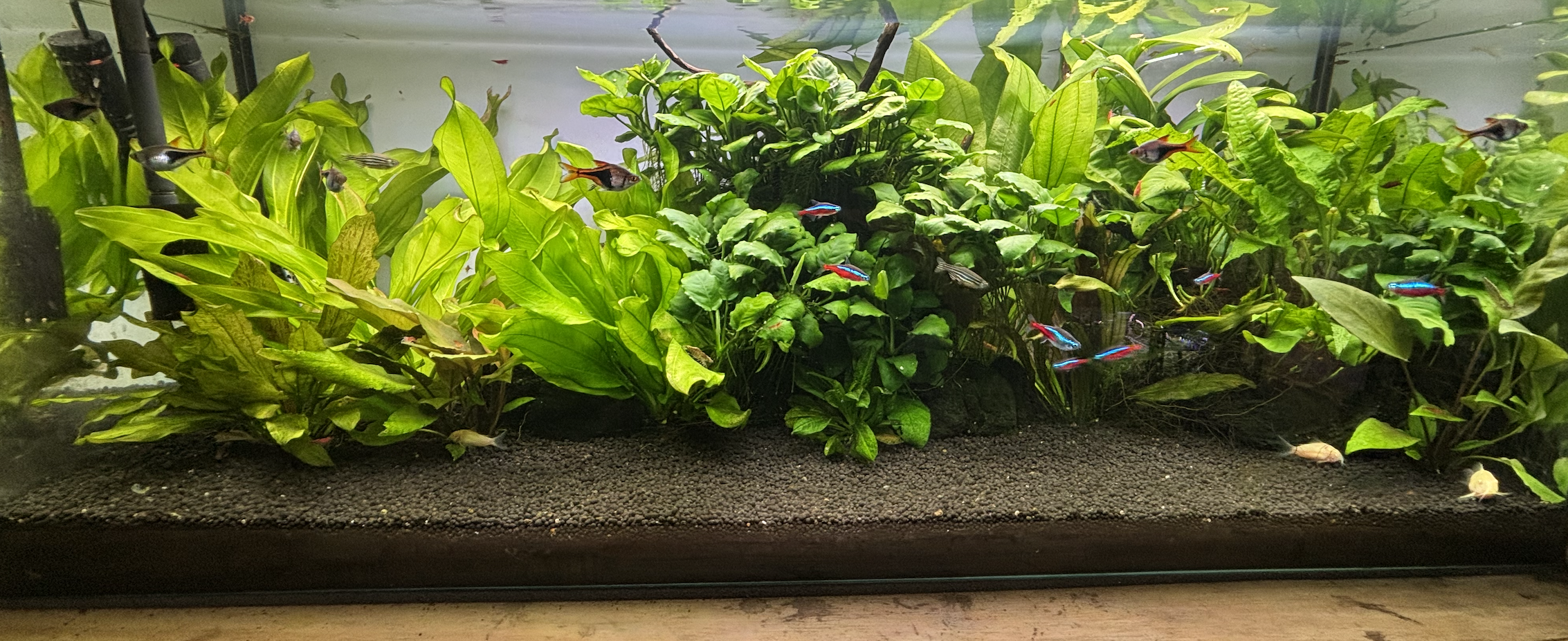
Screenshot 2026-02-02 at 13.39.03.png
 
Last edited:

preben

New Member
Messages
3
In a 54 litre tank i would only kept 1 pair. If it is enough place to hide it shouldnt be a problem to have 1 of each. If the female is going after the male you can just remove him to your bigger tank or remove the fry to a breeder box.
 

MacZ

Well-Known Member
5 Year Member
Messages
4,323
Location
Germany
We can shorten it to one statement:

For breeding (provided holding tanks to separate pairs and growout tanks are available) a 60x30x30cm tank is absolutely sufficient, even smaller (40x30x30) is possible if you can observe and intervene immediately. This applies basically for ALL species. (Maybe except big species like A. kullanderi or A. macmasteri)

For growout I always recommend bigger tanks, because a bigger volume allows for longer periods between the waterchanges.

For a community I would always recommend 80cm plus.

some sources suggest the female can become stressed if the male is constantly breeding/chasing.
Not only some sources, but pretty much every specialist will sign that statement off as true. If you do not intend to breed I would recommend getting just a single male and some tetras. Apistogramma do not have to be kept in pairs (and all species you named are polygamous anyway, so a male will not tolerate a non-receptive female in the tank anyway.)

At first I was leaning towards Apistogramma cacatuoides, but I’ve also read comments about potential genetic issues in some lines due to heavy inbreeding. With that in mind, I’ve been considering A. macmasteri, A. hongsloi, or A. trifasciata instead.
Ironically these genetic problems are found in the species you named too, because all of them are usually only available as domestic colour breeds. The domestiv fish are usually smaller than wild type fish when they colour up and grow bigger. E.g. above the size of A. macmasteri is given with 5.5cm. Sorry to say, the domestic ones easily scratch 8cm.

As for the tanks: Besides having a secondary for separation at hand, you have to make sure the structure is sufficient, providing line of sight blocks from the ground level up to 15cm. If the fish can look (or even swim) underneath or have wide angle views from the end of such a sight block the dominant fish will still claim the whole tank and the other one will be chased relentlessly.
 

Glass Box Diaries

New Member
Messages
20
In a 54 litre tank i would only kept 1 pair. If it is enough place to hide it shouldnt be a problem to have 1 of each. If the female is going after the male you can just remove him to your bigger tank or remove the fry to a breeder box.
Cheers mate :)

We can shorten it to one statement:

For breeding (provided holding tanks to separate pairs and growout tanks are available) a 60x30x30cm tank is absolutely sufficient, even smaller (40x30x30) is possible if you can observe and intervene immediately. This applies basically for ALL species. (Maybe except big species like A. kullanderi or A. macmasteri)

For growout I always recommend bigger tanks, because a bigger volume allows for longer periods between the waterchanges.

For a community I would always recommend 80cm plus.


Not only some sources, but pretty much every specialist will sign that statement off as true. If you do not intend to breed I would recommend getting just a single male and some tetras. Apistogramma do not have to be kept in pairs (and all species you named are polygamous anyway, so a male will not tolerate a non-receptive female in the tank anyway.)


Ironically these genetic problems are found in the species you named too, because all of them are usually only available as domestic colour breeds. The domestiv fish are usually smaller than wild type fish when they colour up and grow bigger. E.g. above the size of A. macmasteri is given with 5.5cm. Sorry to say, the domestic ones easily scratch 8cm.

As for the tanks: Besides having a secondary for separation at hand, you have to make sure the structure is sufficient, providing line of sight blocks from the ground level up to 15cm. If the fish can look (or even swim) underneath or have wide angle views from the end of such a sight block the dominant fish will still claim the whole tank and the other one will be chased relentlessly.
Excellent, thanks for the help mate, I think I might just try to keep males with some small tetras or rasboras :)
 

anewbie

Well-Known Member
5 Year Member
Messages
2,702
I think several of the species really require 60cm min for the larger or more aggressive species. borelli you can get away with 45 and probably alacrina though they are more aggressive.

The other fishes are larger and are going to be cramped - though i suppose some species roam more than others. I would not try hongsloi in a 45 - i mean if you only care about breeding you can do it if you remove the male but if you want to keep them as pets i would definitely want the larger aquarium.

Also i really think a 54 liter tank is too small for any of the listed species but borelli as a full time home.

ALso if you have dithers pick them wisely - that photo show neon tetra which are probably not what you want.

Of course per your final statement keeping the male with neon or cardinals is fine.
 

Glass Box Diaries

New Member
Messages
20
I think several of the species really require 60cm min for the larger or more aggressive species. borelli you can get away with 45 and probably alacrina though they are more aggressive.

The other fishes are larger and are going to be cramped - though i suppose some species roam more than others. I would not try hongsloi in a 45 - i mean if you only care about breeding you can do it if you remove the male but if you want to keep them as pets i would definitely want the larger aquarium.

Also i really think a 54 liter tank is too small for any of the listed species but borelli as a full time home.

ALso if you have dithers pick them wisely - that photo show neon tetra which are probably not what you want.

Of course per your final statement keeping the male with neon or cardinals is fine.
Thanks for the help, I saw @MacZ say Apistogramma Borelli are the least aggressive Apisto in this thread so have been watching some YouTube videos specific to them and think they might be the one I go with :).

Do either of you know if they also have genetic problems like the other varieties I mentioned earlier or are they hardy?

Also, the shop only sells them as male/female pairs so I might have to look for another shop selling them if I can only keep a male in a 54 litre tank.
 

anewbie

Well-Known Member
5 Year Member
Messages
2,702
My pleasure! Good luck, post pictures when it's done.

There's one P. innesi in the picture, the rest are P. axelrodi.
I suppose but the cardinal is like-wise in the same boat ;) Though in my 100 i have some cardinals with the norberts and they stay far away from each other.
 

Kirsten

New Member
Messages
4
Hi everyone,

I’m hoping to get some confirmation on appropriate tank sizes for different types of Apistogramma, as I’m finding a lot of conflicting information online.

Below is a table showing the Apistogramma species available in my area, along with their suggested lengths and tank sizes according to Seriously Fish.

Are they accurate?

View attachment 17513

I’m looking for recommendations on Apistogramma varieties that would do well in a 54-litre tank (60 × 30 × 30 cm). The tank will be heavily planted with broad-leaf plants like Anubias and Echinodorus, and the Apistogramma will be the only fish species in the setup.

My original plan was to keep a pair (1 male and 1 female), but I’ve seen mixed advice—some sources suggest the female can become stressed if the male is constantly breeding/chasing. Because of that, I’m also open to keeping a single male if that’s the better option.

I’m planning two separate 54-litre tanks.

At first I was leaning towards Apistogramma cacatuoides, but I’ve also read comments about potential genetic issues in some lines due to heavy inbreeding. With that in mind, I’ve been considering A. macmasteri, A. hongsloi, or A. trifasciata instead.

Any suggestions would be appreciated.

The photo below shows the kind of planting style I’m aiming for—this example is from my 160-litre tank, but the 54-litre tanks will use smaller plant varieties with a similar level of cover.

View attachment 17514
Please can someone help with ranking the sizes of the different species, at least the most common ones? I noticed that no-one responded to your question about how accurate this table is! For myself I've made a similar table and also found that different sources give wildly different values; for example both A. baenschi and A. macmasteri are shown on other sites with maximum size up to more than 10cm (which would even take them out of the 'dwarf' cichlid category!). Also Ivanacara bimaculata have reported maximum sizes ranging from 5 cm to 13 cm. Previously I had a some A. trifasciata, which did very well in my tanks (with other smaller fish), but I could not bring them when I moved house. Since then I have tried to find a species that is not larger than A. trifasciata. A local fish store sold me a pair of well-coloured A. cacatuoides, both around 4 cm, but in just a couple of months the male grew to almost double that size, and he is probably still growing. He looks fine, but terrorises everyone else in the tank, including the female, even though the tank is well planted and with good hiding places (if it wasn't, the others might have been dead by now...). The other fish are Otocinclus and Iriatherina werneri, both do fine with A. trifasciata, with them I could even keep cherry shrimp. The store is OK to take the cichlids back, and they have also offered to order a species for me that they don't have in stock. However, before I ask them to do this, I want to know more about what size to expect. In a way I am relieved to see that I am not the only one with this problem!
In fact, a ranked list of sizes of the different Apistogramma species could be a very useful resource generally, in particular for newcomers like myself. I appreciate that it can be difficult to give an absolute size value for a single species, since it will depend on age and other factors. However, those members who keep more than one species will be able to give definitive rankings regarding which species are larger or smaller than others. Since the issue of size also relates to temperament (compatibility with other species), the list could also include some information on this; that is, if two species have a similar size, if one of them is less aggressive than the others.
Would someone want to give it a start by ranking those species they have experience with, by size and maybe also temperament? Then others could add their experiences, to extend or modify the list.
Thank you all very much in advance!
 

Attachments

  • Cacatuoides han Jan 26.jpg
    Cacatuoides han Jan 26.jpg
    3.4 MB · Views: 116
  • Apisto male sm.jpeg
    Apisto male sm.jpeg
    488.4 KB · Views: 275

MacZ

Well-Known Member
5 Year Member
Messages
4,323
Location
Germany
Please can someone help with ranking the sizes of the different species, at least the most common ones? I noticed that no-one responded to your question about how accurate this table is
Because we all immediately pointed out the basics don't have to be put in a table. There are less than ten species that actually require bigger minimum tank sizes and less than 5 that can be kept in smaller tanks and only 2 of those are regularly available in the trade.
All of that of course

Sorry to disappoint, but my take is, the general consensus is to treat all the same in terms of tank size, using a generally accepted minimum (60x30x30cm) that will work if the best practice of having separation tanks and growout at hand is considered.

Things like individual temperament can be ignored under such circumstances. In my experience there is only one species with a possible general temperament statement and that's A. borellii.

I can underdtand why you ask for such a list, but from a point of view of someone with some experience in dwarf cichlids it seems kind of useless.
 

Kirsten

New Member
Messages
4
Because we all immediately pointed out the basics don't have to be put in a table. There are less than ten species that actually require bigger minimum tank sizes and less than 5 that can be kept in smaller tanks and only 2 of those are regularly available in the trade.
All of that of course

Sorry to disappoint, but my take is, the general consensus is to treat all the same in terms of tank size, using a generally accepted minimum (60x30x30cm) that will work if the best practice of having separation tanks and growout at hand is considered.

Things like individual temperament can be ignored under such circumstances. In my experience there is only one species with a possible general temperament statement and that's A. borellii.

I can underdtand why you ask for such a list, but from a point of view of someone with some experience in dwarf cichlids it seems kind of useless.
For someone like me, with very limited experience with dwarf cichlids, it would be very helpful if the more experienced members would share this experience in an easily accessible way. If the various internet sources like Seriously Fish and Fishbase provided consistent and clear information, then this would not be necessary. But since they don't, I can't think of a better way to do it than such a table; any suggestions?
In the meantime, could you please tell me what I specifically need to know: which Apistogramma species (or similar genera like Ivanacara, Dicrossus etc. ) are smaller than or the same size as A. trifasciata?
 

MacZ

Well-Known Member
5 Year Member
Messages
4,323
Location
Germany
You are missing my point. I know that you might find it helpful, but the requirements all can be said in one single paragraph. (see my posts above)

And about sizes otherwise: The term "dwarf cichlid" collects south american and west/central african cichlids under 10cm length, with very few singular exceptions and those should not bother you until you enter an intermediate stage.

It's easier to tell you which commonly available species are bigger than A. trifasciata: A. cacatuoides, A. macmasteri, A. hongsloi and for good measure because they have been discussed often lately: A. kullanderi and A. baenschi.

Also all Ivanacara grow bigger than A. trifasciata and I have seen specimens scratching 12cm.

That's the simple and short answer.
I wouldn't be worried about less than 1.5cm difference, but the species I named regularly exceed the size of A. trifasciata by more than that margin.
 

Mike Wise

Moderator
Staff member
5 Year Member
Messages
11,869
Location
Denver, Colorado, U.S.A.
Doesn't anyone own books anymore? They tend to be more accurate than anything on the web. As for Fishbase vs. Seriously Fish sizes, Fishbase is based on information on wild fish describedd in the original description while Seriously Fish uses domestically raised fish. Fishbase uses standard length while others might use total length. All of this produces the different sizes listed.
 

Glass Box Diaries

New Member
Messages
20

We have a search function and a dozen threads dedicated to that question.
Thanks for the thread link :)

Doesn't anyone own books anymore? They tend to be more accurate than anything on the web.
Are the books in that thread the ones you recommend?

I can't see people paying $80 to $148 for a book to get confirmation on tank sizes for Apistogramma in the age of the internet...
 

Mike Wise

Moderator
Staff member
5 Year Member
Messages
11,869
Location
Denver, Colorado, U.S.A.
Are the books in that thread the ones you recommend?
Yes, especially the ones by Koslowski, Römer and DATZ
I can't see people paying $80 to $148 for a book to get confirmation on tank sizes for Apistogramma in the age of the internet...
The old adage, "you get what you pay for", applies here. Yes, the internet information is free but this is why you have found so much conflicting results. Each has an opinion of the writer with no one else (a technical editor) checking the results.
 

anewbie

Well-Known Member
5 Year Member
Messages
2,702
Well on the other hand most of the books references are very out of date with regards to newer fishes having been discovered. Someone said that romer was in the process of a release of his book with updates but not sure if that is still going to happen.
 

Glass Box Diaries

New Member
Messages
20
Yes, the internet information is free but this is why you have found so much conflicting results.
Before I start trying to track these books down at more affordable prices, I just want to confirm — do the sources from Koslowski, Römer, and DATZ generally align with one another, or are there as many discrepancies between them as there are with the free information available online?
Well on the other hand most of the books references are very out of date with regards to newer fishes having been discovered.
Great point mate.

It’s 2026 — I think most people today would expect a site literally called apistogramma.com to have regularly updated, stickied threads with clear tank size recommendations.

Ideally, these would be informed by respected community members who actually keep the different varieties, all contributing their real-world experiences to a single master list.
 

anewbie

Well-Known Member
5 Year Member
Messages
2,702
Before I start trying to track these books down at more affordable prices, I just want to confirm — do the sources from Koslowski, Römer, and DATZ generally align with one another, or are there as many discrepancies between them as there are with the free information available online?

Great point mate.

It’s 2026 — I think most people today would expect a site literally called apistogramma.com to have regularly updated, stickied threads with clear tank size recommendations.

Ideally, these would be informed by respected community members who actually keep the different varieties, all contributing their real-world experiences to a single master list.

There is no clear tank size for all fishes - fishes behavior while generalized come down to individual. In addition how you scape a tank (including having lots of very large leaves that are constantly updated) make a huge difference in what tank size works.

It is like saying all pit bulls are easy going lovable dog and then encountering one that rips your throat out.
 

Members online

No members online now.

Forum statistics

Threads
18,703
Messages
124,172
Members
13,589
Latest member
rozyjuise

Latest profile posts

Platforma SaldeoSMART automatyzuje obieg dokumentów i odczyt faktur (OCR) w firmach oraz biurach rachunkowych. System jest gotowy na zmiany prawne, a integracja z ksef pozwala na bezpieczne wysyłanie i odbieranie e-faktur ustrukturyzowanych.
dimandobson wrote on Ben Bergman's profile.
Hi Bergman. I have a pair of breeding dwarf cichlid for sale. if you are still looking, drop me your whatsapp number and i will send some videos to your whatsapp
Good-backlink.com - Professional website promotion, get more traffic to your website and improve ranking by using high PR link building service.
martin_c wrote on illumnae's profile.
Hi,

just in case you happen to live in Germany (or Netherlands): I have a wildcaught female A. psammophila, you could have it for free. I have no use for it anymore.

BR
Martin
Top