• Hello guest! Are you an Apistogramma enthusiast? If so we invite you to join our community and see what it has to offer. Our site is specifically designed for you and it's a great place for Apisto enthusiasts to meet online. Once you join you'll be able to post messages, upload pictures of your fish and tanks and have a great time with other Apisto enthusiasts. Sign up today!

Feedback On Apistogramma Tank Plans :).

Glass Box Diaries

New Member
Messages
20
Morning guys,

I’m looking for some feedback on two Apistogramma tanks I’m currently in the process of setting up. I’m particularly interested in opinions on my stocking ideas, the overall plant density, and the foreground areas of the layouts.

I’ve seen some sources recommend using lots of leaf litter, while others suggest filling the foreground with plants, rocks, or driftwood instead, so I’m curious what people here have found works best.
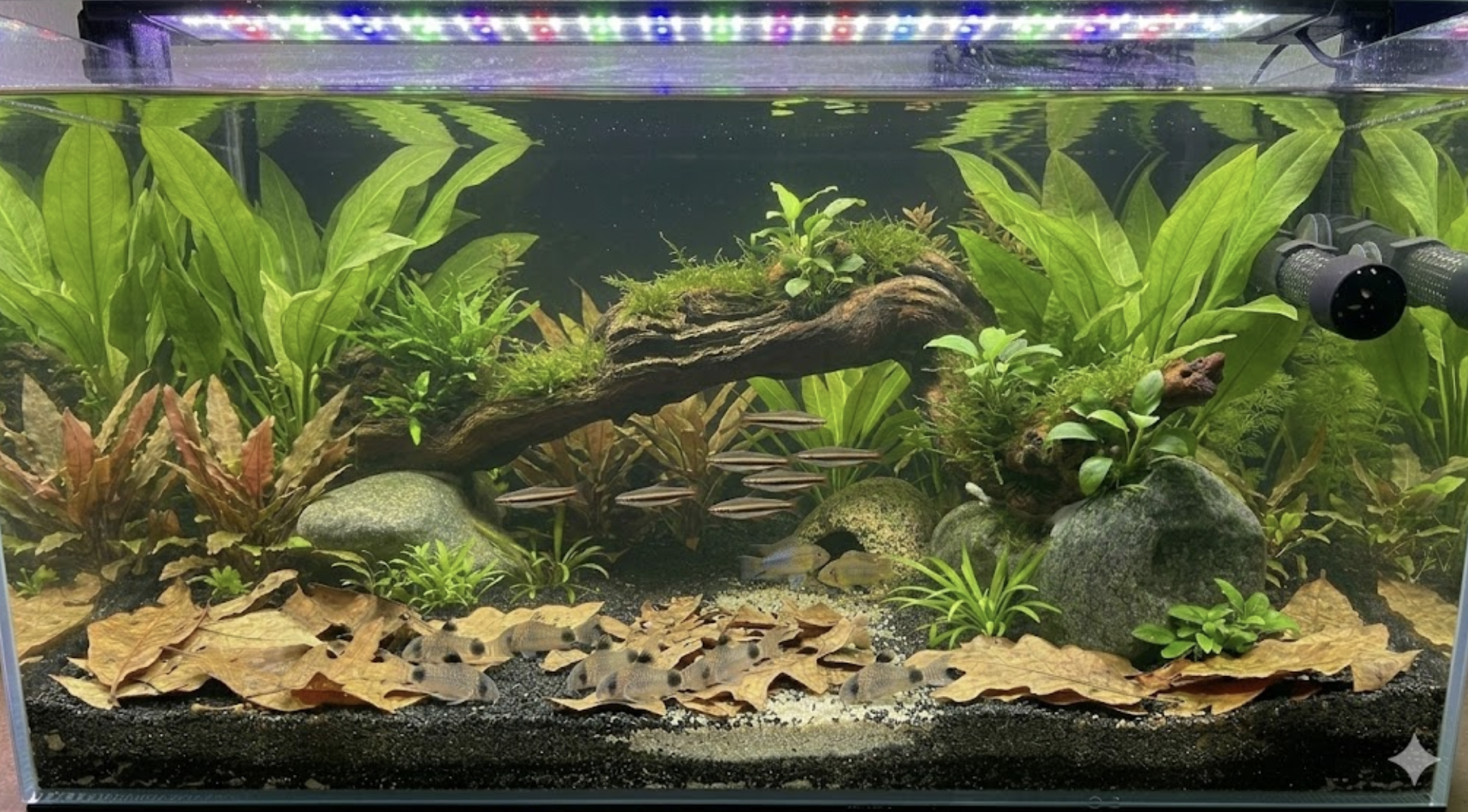
Tank 1​

Screenshot 2026-03-05 at 10.43.16.png

This is a 70-litre tank (60 × 40 × 30 cm). The tank itself, along with the sand substrate, accessories, and hardscape, are all real, but I used AI to generate the plants, leaf litter, and fish to help me plan the layout.

At the moment, I’m considering stocking the tank with Apistogramma borellii, along with pencilfish and panda corydoras. I already have access to plants that match the proportions of the AI-generated ones, so recreating the planting shouldn’t be an issue. The back two-thirds of the tank would be heavily planted.

I've also seen people say that Apistogramma don't actually need caves and will happily use plants/leaf litter if they choose to breed so not sure about having a cave.

I have plenty of small oak leaves that I normally use as shrimp food, as well as Indian almond leaves that are larger than my hand, so I could use those to create a leaf-litter foreground. However, I could also add small crypts, swords, or other plants in certain areas if that would work better.
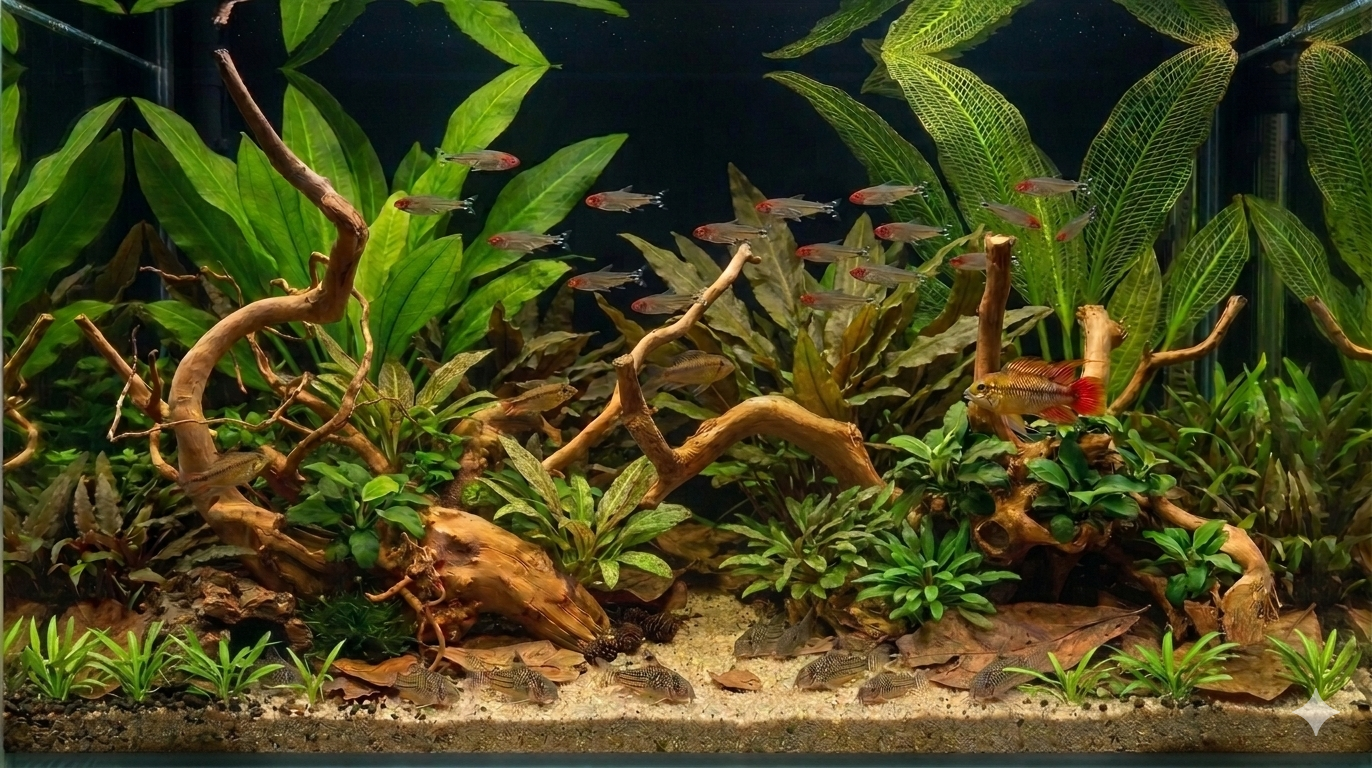
Tank 2​

40 Gallon Complete.png

This will be a 160 litre tank (100 × 40 × 40 cm). The only real element in this layout is the wood—everything else was generated with AI. Because of that, the dimensions in the image aren’t quite right since I don’t actually have the aquarium yet. The driftwood is also slightly larger in real life than what the AI rendered.

At the moment, I’m considering keeping either two Apistogramma cacatuoides or two Apistogramma macmasteri, along with rummy nose tetras and peppered corydoras.

Similar to my other plan, I can easily source plants with similar sizes and proportions to the ones shown here, so recreating the layout shouldn’t be too difficult. I will be adding more Anubias to the driftwood though—the AI kept struggling to place it properly when I tried to include it.

There will also be more leaf litter than shown. Again, the AI had trouble adding it without affecting the rest of the layout, but I like the idea of using larger leaves in the foreground instead of plants since that’s something I don’t currently have in any of my other aquariums.
 

MacZ

Well-Known Member
5 Year Member
Messages
4,323
Location
Germany
First of all: You have done some very good researching, I'll give you that. just a few comments:

I’ve seen some sources recommend using lots of leaf litter, while others suggest filling the foreground with plants, rocks, or driftwood instead, so I’m curious what people here have found works best.
This doesn't conflict. The point of not having too big open spaces is to prevemnt a dominant fish from claiming the whole tank. So the use of rocks, wood and plants is to give structure to align territories with.

This is a 70-litre tank (60 × 40 × 30 cm)
Then please leave the catfish. A. borellii are not very territorial, but a swarm of Corydoracoid catfish will simply overrun them. Especially in terms of food competition. If you get Gastrodermus pygmaeus or hastatus or Hoplisoma habrosum instead it might work with a single male A. borellii.

I've also seen people say that Apistogramma don't actually need caves and will happily use plants/leaf litter if they choose to breed so not sure about having a cave.
If you don't want to breed, I would rather stick to getting a single male. Otherwise the statement is true: Except for breeding there is no need for caves.

I have plenty of small oak leaves that I normally use as shrimp food, as well as Indian almond leaves that are larger than my hand, so I could use those to create a leaf-litter foreground. However, I could also add small crypts, swords, or other plants in certain areas if that would work better.
Why not both? Important: The fish can (and will) move leaves aside to reach the substrate to sift it through, while ground-covering plants will prevent this long term.


This will be a 160 litre tank (100 × 40 × 40 cm).
Again, the combination with catfish is far from optimal. Additionally: Petitella tetras (all three species have been moved to this genus) give smaller tanks a rather hectical appearance. This is due to the fact that in smaller space the usual swarm behaviour simply goes poof. While other tetras like P. axelrodi tend to move to a fixed position in a small territory, Petitella keep swimming but the swarming behaviour needs space, so they start to swim all over the place. Optimal for these tetras are groups of at least 40-50 in a 150-200cm length tank so they can really shine

When looking at A. cacatuoides and A. macmasteri I can only advise to make sure the structure in the tank is really pronounced. Otherwise females tend to get harassed until they drop dead, while the males may also be target if the females breed.

Also the structure needed goes against the needs of the catfish.

Look at it this way: These catfish tend to live towards the center of the bed of a creek, where there is more open sand, less leaf litter and much higher current. Additionally to that they only need some twigs and branches for cover, which allow them to rest under in safety buit to escape from in any direction. Apistogramma stick to areas with less current and more leaf litter and prefer to use structures to separate territories.

Hope this helps. :)

And a litte addition: If yu want to combine Apistos with Hoplisoma etc. 150x50cm footprint is the best ratio. Then you can designate areas fitting for both.
.
 

Glass Box Diaries

New Member
Messages
20
Then please leave the catfish.
Thanks for the help mate :) I think this is the key point and I will leave catfish out of both setups.

One of the main reasons I wanted so much space in the foreground was for the catfish as my current corydoras seem to love open space in the foreground of their tanks but they are just regular community tanks.

Leaving the corydoras out lets me use up more of the foreground with plants and leaf litter :)
 

Mike Wise

Moderator
Staff member
5 Year Member
Messages
11,869
Location
Denver, Colorado, U.S.A.
Also note that rummy-nose tetras have a reputation for being fry predators, like many blackwater tetra species. They are not a good addition to a breeding tank. In a community tank where apisto breeding is not possible (only 1 sex) they are OK.
 

anewbie

Well-Known Member
5 Year Member
Messages
2,702
Two comments: I would make sure that black substrate is inert and if possible use something a little finer grain.

It is quite possible to breed apistogramma with pygmy cory. The pygmy turn out to be very timid and will not ignore attacks from another fish instead they will tend to stay away from such a fish who has harassed them.

At least that is my experience in mixing them. Do not take this as encouragement to mix them but they are not nearly as bad as the other cory that will create undo stress on a breeding female by ignoring her attacks and swarming her (though they don't actually seem to eat eggs or frys).
 

Glass Box Diaries

New Member
Messages
20
Also note that rummy-nose tetras have a reputation for being fry predators, like many blackwater tetra species. They are not a good addition to a breeding tank. In a community tank where apisto breeding is not possible (only 1 sex) they are OK.
Thanks for the feedback mate, I initially saw some sources saying they had to be kept in pairs but the more I research and spoke to people who actually keep them the more people said a single male or female is perfectly fine in a tank.

One potential issue is that the shop I want to get them from (excellent reputation) only sells them in pairs/trios but after seeing better photographs of the females I think they look good too so I might keep the male in one tank and the female in another both serving as a center piece in their respective tanks.
Two comments: I would make sure that black substrate is inert and if possible use something a little finer grain.
Cheers mate, just realized this photograph is the one where I was getting the AI to change the color of the substrate to see what it would look like.

The actual substrate is the JBL Sansibar fine sand with a grain size of 0.2-0.6mm :)
 

Phil_1983

Member
Messages
87
Location
Germany, NRW
If You have not already bought and used the JBL sand you could try to get really fine quartz sand. In Germany 20 € will get you a 25kg bag and it looks and feels like the JBL (natural colored) - in my opinion at least.

Some of the companies here offer a inert black version as well, but I do not have any experience with this stuff.
 

MacZ

Well-Known Member
5 Year Member
Messages
4,323
Location
Germany
I have always used “play sand” in the tanks I’ve have over the years. It is inert and never needs vacuuming.
Not much rinsing required either.
But very important: There are play sands that have additives to keep cats and dogs away or to prevent children from eating it (similar to that bitter stuff used to keep them from nail biting. Anyone who hasn't found "their" brand like you should check for that. :)
 

anewbie

Well-Known Member
5 Year Member
Messages
2,702
In usa i use hth pool filter sand which i believe is around .5 mm rounded. I believe play sand is finer but of course there are different brands with different properties. @MacZ does raise an important point that all of these 'substrates' not designed for aquariums are subject to change in ways that would be negative for fishes.
 

Members online

Forum statistics

Threads
18,703
Messages
124,172
Members
13,589
Latest member
rozyjuise

Latest profile posts

Platforma SaldeoSMART automatyzuje obieg dokumentów i odczyt faktur (OCR) w firmach oraz biurach rachunkowych. System jest gotowy na zmiany prawne, a integracja z ksef pozwala na bezpieczne wysyłanie i odbieranie e-faktur ustrukturyzowanych.
dimandobson wrote on Ben Bergman's profile.
Hi Bergman. I have a pair of breeding dwarf cichlid for sale. if you are still looking, drop me your whatsapp number and i will send some videos to your whatsapp
Good-backlink.com - Professional website promotion, get more traffic to your website and improve ranking by using high PR link building service.
martin_c wrote on illumnae's profile.
Hi,

just in case you happen to live in Germany (or Netherlands): I have a wildcaught female A. psammophila, you could have it for free. I have no use for it anymore.

BR
Martin
Top