• Hello guest! Are you an Apistogramma enthusiast? If so we invite you to join our community and see what it has to offer. Our site is specifically designed for you and it's a great place for Apisto enthusiasts to meet online. Once you join you'll be able to post messages, upload pictures of your fish and tanks and have a great time with other Apisto enthusiasts. Sign up today!

Parasites and wild caught food

jorgeopl

New Member
Messages
5
Here's a brainstorm, let me know if the way I'm going at this is reasonable.

I live in Buenos Aires, my parents have their place by a lake. Copepods (cyclops) have daily vertical migrations, they're all on the surface when you trawl at night. I catch them by the gram once or twice a month and feed them frozen and live. Beyond that, I also feed cultured bloodworms, mosquito larvae and daphnia, all cultured, and (cripppled beforehand) damselfly and backswimmer nymphs. I've been cautioned against parasites and the like, but my reasoning is that we oftentimes "seed" our aquariums with mulm and mud from other aquariums, the fish themselves have pathogens and parasite loads from before, and the problem isn't presence of parasite loads but poor husbandry causing low immune system.

When it comes to the nutrition, this I know to be beyond ideal. If I got these from a ditch, pollutants would be a problem (not the case). But there are parasites theoretically using copepods as hosts. Does that danger outweigh the clear benefits? Should I stick to frozen? When I'm not going to be there a couple of days, pulding live food is awfully convenient and, not going to lie, very entertaining to watch.

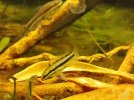
Trifasciata (pair) and some beckfordis as well as otos and a couple ghost shrimp.

Apologies on the poor quality of the pictures. Might try to get better ones when I get back home.
 

Attachments

  • WhatsApp Image 2026-02-12 at 10.51.34.jpeg
    WhatsApp Image 2026-02-12 at 10.51.34.jpeg
    193.3 KB · Views: 83
  • WhatsApp Video 2026-02-12 at 10.54.18.mp4
    6.6 MB

MacZ

Well-Known Member
5 Year Member
Messages
4,323
Location
Germany
Let's put it short and simple: Unless you collect species of invertebrates as live food known to harbour a stage of the livecycle of a parasite (e.g. Myxobolus cerebralis in Tubifex and swamp snails) you are most likely safe. Because keep in mind: A parasite cannot survive outside a host for long. Usually under 12 hours.

Now for things like worm eggs: Those can definitley pose a problem, so having something like Praxiquantel on hand would be a good idea.

So if you haven't had any problems by now, I'd say your fish are fine, but keep a close eye.
 

Eddy. E.

Active Member
Messages
98
Location
Germany
When live food is fed, there is always a risk of parasites. Copepods are known to serve as intermediate hosts for Acanthocephala spec. and Diphyllobothrium spec.
Cestoda spec. also use Cyclops as an intermediate host.
If, for example, red mosquito larvae are fed, it can be safely assumed that Aeromonas and Cyrtocara bacteria will be introduced, which are significantly more dangerous to our fish than worm parasites. Even in a seemingly harmless case of Exophthalmos, you are facing Corynebacterium aquaticum which is often found in the tissue behind the eye, where it releases toxins that inflame the tissue. This results in fluid accumulation behind the fish's eye and the swelling pushes the eye outwards.
 

dw1305

Well-Known Member
5 Year Member
Messages
2,979
Location
Wiltshire UK
Hi all,
If, for example, red mosquito larvae are fed, it can be safely assumed that Aeromonas and Cyrtocara bacteria will be introduced, which are significantly more dangerous to our fish than worm parasites
Is that true for Chironomid larvae in general? I <"ranch"> my own in fairly clean water, but I won't feed <"commercially collected"> larvae.

cheers Darrel
 

Eddy. E.

Active Member
Messages
98
Location
Germany
Hi all,

Is that true for Chironomid larvae in general? I <"ranch"> my own in fairly clean water, but I won't feed <"commercially collected"> larvae.

cheers Darrel
Hello Darrel,

The most common types of bacteria that cause problems in or on our fish and that have been isolated through testing are:

Aeromonas hydrophila
Shewanella spp.
Citrobacter freundii
Plesiomonas
Edwardsiella tarda
Pseudomonas spp.
Flavobacterium spp.

Of these bacterial species, Aeromonas is most strongly involved in a wide variety of diseases and lives in our fish, in the water, in the soil, basically in the entire aquatic environment.
In contrast to Citrobacter freundii, which is part of the normal intestinal flora of healthy fish and does not cause them any discomfort, A. hydrophila is considered pathogenic in the gastrointestinal tract of fish. However, if these two bacteria gain access to the blood, for example through parasitism by a flagellate such as Spironucleus or internal worms such as Capillaria, they can cause some of the most serious primary or secondary fish diseases known. One example is infectious ascites, dropsy. Aeromonas and Citrobacter attack the liver, kidneys and other internal organs.
Both species destroy the cell membrane of red blood cells using haemolysin. Cytotoxic enterotoxin causes the epithelial tissue in the intestine to die off, leading to inflammation and ultimately bringing the fish's entire nutrient cycle to a standstill. The liver and kidneys are no longer supplied with nutrients, leading to organ failure and ultimately death.

It doesn't matter what you feed them because bacteria are always present. Our concern should therefore be to take precautions against bacterial problems. Worms are certainly a serious issue, but bacteria don't care whether the fish live or die.
 

Members online

No members online now.

Forum statistics

Threads
18,703
Messages
124,172
Members
13,589
Latest member
rozyjuise

Latest profile posts

Platforma SaldeoSMART automatyzuje obieg dokumentów i odczyt faktur (OCR) w firmach oraz biurach rachunkowych. System jest gotowy na zmiany prawne, a integracja z ksef pozwala na bezpieczne wysyłanie i odbieranie e-faktur ustrukturyzowanych.
dimandobson wrote on Ben Bergman's profile.
Hi Bergman. I have a pair of breeding dwarf cichlid for sale. if you are still looking, drop me your whatsapp number and i will send some videos to your whatsapp
Good-backlink.com - Professional website promotion, get more traffic to your website and improve ranking by using high PR link building service.
martin_c wrote on illumnae's profile.
Hi,

just in case you happen to live in Germany (or Netherlands): I have a wildcaught female A. psammophila, you could have it for free. I have no use for it anymore.

BR
Martin
Top