• Hello guest! Are you an Apistogramma enthusiast? If so we invite you to join our community and see what it has to offer. Our site is specifically designed for you and it's a great place for Apisto enthusiasts to meet online. Once you join you'll be able to post messages, upload pictures of your fish and tanks and have a great time with other Apisto enthusiasts. Sign up today!

Male cockatoo agression. How to resolve

bcs

New Member
Messages
16
I got a wild male cockatoo a while back, and recently I found a female (or at least it should be) cockatoo double red (regrettable but I’m still happy). I introduced the female to the males tank, as I was led to believe that this would be fine for both parties. I’ve rearranged decor, but some agression persists. Is this normal? Is there something I can do to resolve this issue?
Tank size 20 long
Inhabitants
Male cockatoo
Female cockatoo
One baby endler that doesn’t seem to ever get eaten.
I feed frozen brine shrimp and blood worms, do water changes once a week.

This one is post feeding.
 

Attachments

  • IMG_9238.jpeg
    4.3 MB · Views: 118
Last edited:

bcs

New Member
Messages
16

This is a typical spat. It’s not constant but it makes me nervous. Should I separate?
 

anewbie

Well-Known Member
5 Year Member
Messages
2,702
It is normal can persist for a while. If she is sexually mature eventually it might work - could be 2 or 3 weeks. Having some large leaves she can hide under would help as well as a larger aquarium. With the constrained area it could end badly. If she is not sexually mature then yea i would remove her if she is then removing her won't help much as the same issue will occur when you re-add her.
 

bcs

New Member
Messages
16
It is normal can persist for a while. If she is sexually mature eventually it might work - could be 2 or 3 weeks. Having some large leaves she can hide under would help as well as a larger aquarium. With the constrained area it could end badly. If she is not sexually mature then yea i would remove her if she is then removing her won't help much as the same issue will occur when you re-add her.
How can you tell if she is sexually mature?
 

MacZ

Well-Known Member
5 Year Member
Messages
4,323
Location
Germany
Looking at the second video, considering the size-difference between the two, she is. The tank is lacking in structure and it is too small to keep them together in it permanently if that isn't changed.

In many Apistogramma species the males do not tolerate females in their territory unless they are receptive to mating. It does not seem like she is ready to breed, hence the chasing. If she is stressed out too much this will not set in, instead it is possible that she shuts down and dies from stress.

I would look at the problem for maybe 2-3 more days, then remove her and keep them separate until you are ready to rescape the tank for proper structure then also remove the male, rework the tank and add them both together. It is important you remove them both before rescaping so there are no established territories.

What I mean by structure: Wood and rocks serving as breakers of lines of sight. Usually glass to glass and about 10-15cm high above the sand. The fish should not be able to overlook too big areas and not look, let alone swim, underneath the wood.

After all this if she doesn't colour up yellow and the chasing continues, separating is always the first thing to do.
 

bcs

New Member
Messages
16
Looking at the second video, considering the size-difference between the two, she is. The tank is lacking in structure and it is too small to keep them together in it permanently if that isn't changed.

In many Apistogramma species the males do not tolerate females in their territory unless they are receptive to mating. It does not seem like she is ready to breed, hence the chasing. If she is stressed out too much this will not set in, instead it is possible that she shuts down and dies from stress.

I would look at the problem for maybe 2-3 more days, then remove her and keep them separate until you are ready to rescape the tank for proper structure then also remove the male, rework the tank and add them both together. It is important you remove them both before rescaping so there are no established territories.

What I mean by structure: Wood and rocks serving as breakers of lines of sight. Usually glass to glass and about 10-15cm high above the sand. The fish should not be able to overlook too big areas and not look, let alone swim, underneath the wood.

After all this if she doesn't colour up yellow and the chasing continues, separating is always the first thing to do.
Thanks! Will do. This line of sight break should be right down the middle? I tried to do it with plants and leaves, but I can facilitate stones.
 

MacZ

Well-Known Member
5 Year Member
Messages
4,323
Location
Germany
This line of sight break should be right down the middle?
That's your decision. Diagonal, long axis, short axis, middle, parting into thirds...

I tried to do it with plants and leaves,
These have the tendency to not be sufficient. Leaves can be moved and change shape, plants have to be really dense thickets, which is not the case in your tan, because the plants in it do not form the type of thicket necessary.
 

Mike Wise

Moderator
Staff member
5 Year Member
Messages
11,869
Location
Denver, Colorado, U.S.A.
When this occurs with my fish I remove the male from the breeding tank, redecorate and allow the female to become adjusted to the 'new' surroundings. Only after this (a few weeks and she is ready to spawn) do I put the male in the tank. It is important that the female is fully mature and ready to breed. Note that it is the female in apistos that initiates breeding. If she is not ready then the male cockatoo will try to remove her.
 

anewbie

Well-Known Member
5 Year Member
Messages
2,702
That's your decision. Diagonal, long axis, short axis, middle, parting into thirds...


These have the tendency to not be sufficient. Leaves can be moved and change shape, plants have to be really dense thickets, which is not the case in your tan, because the plants in it do not form the type of thicket necessary.
I think you are mistaken - if the leaves are very large and suffiicent they seem to work better than most other types of boundaries such as driftwood. The issue is (and mistake a lot of people make) is adding 'caves' and saying they have all these caves to hide in - caves are of course death traps; but large leaves provide excellent places to hide and it is fine if they change shape and decay over time as long as new ones are added.

Drift wood works ok some of the time but like caves they risk creating death pockets where a fish can get trapped by the aggressor. This is something leaves avoid as the fish can swim through them or move them as needed.

That is my observation with the many aquariums i currently have setup with different species. And in fact frequently the fish being chased will swim in a tight circle to get back under a leaf after which the aggressor will quickly give up.
 

anewbie

Well-Known Member
5 Year Member
Messages
2,702
In case it is not clear i'm talking about leaf liter where the leaves are larger than 2inch x 4inch - with some as large as 6 x 4.
 

Ben Rhau

Apisto Club
5 Year Member
Messages
699
Location
San Francisco
I've tried quaranting a pair in a 10 gallon tank with the bottom covered with many pieces of PVC, where the fish could hide but also escape. That didn't stop the chasing, and I had to separate them. I put a divider in the tank and the female did get very yellow (ready for breeding). but when I removed the divider, the male went right back to chasing and the female would become pale again.

I moved the same pair to a 20 long with a lot of structure (driftwood, plants etc) so that there were regions of the tank that couldn't be seen by fish in the other regions. The pair spawned in less than a week, as the female was able to present when she was ready, and the male's territory was not the entire tank.

Leaves alone would not have worked in my 10 gallon, because the aggressor can see where the other fish went to hide. I would guess that the leaves worked in @anewbie's case because his tanks are much larger. Harder to scan the whole tank.
 

bcs

New Member
Messages
16
I've tried quaranting a pair in a 10 gallon tank with the bottom covered with many pieces of PVC, where the fish could hide but also escape. That didn't stop the chasing, and I had to separate them. I put a divider in the tank and the female did get very yellow (ready for breeding). but when I removed the divider, the male went right back to chasing and the female would become pale again.

I moved the same pair to a 20 long with a lot of structure (driftwood, plants etc) so that there were regions of the tank that couldn't be seen by fish in the other regions. The pair spawned in less than a week, as the female was able to present when she was ready, and the male's territory was not the entire tank.

Leaves alone would not have worked in my 10 gallon, because the aggressor can see where the other fish went to hide. I would guess that the leaves worked in @anewbie's case because his tanks are much larger. Harder to scan the whole tank.
Fair enough that you. I was using scavenged hardscape, and it might not be cutting it. I’ll pull the trigger on some more structure. Can I see a picture of any of your successful tanks for reference? It’s hard to do some of these things (as seen in this instance) without good reference. Also would stone work? River stone in particular as I can likely find that quicker more affordably
 
Last edited:

Ben Rhau

Apisto Club
5 Year Member
Messages
699
Location
San Francisco
Yeah, I would personally add bigger pieces and stack them higher. It took more wood than I thought.

If you're able to separate the fish now, you may be able to add the wood more slowly. There will be some oxygen demand if you add a lot at once. Make sure you have good surface agitation.
 

bcs

New Member
Messages
16
Yeah, I would personally add bigger pieces and stack them higher. It took more wood than I thought.

If you're able to separate the fish now, you may be able to add the wood more slowly. There will be some oxygen demand if you add a lot at once. Make sure you have good surface agitation.
Will do. Thanks.
 

Ben Rhau

Apisto Club
5 Year Member
Messages
699
Location
San Francisco
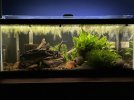
I've attached a couple pictures of my 20 long. The one that's called "apisto" is the one I'm talking about where they successfully bred. You can see two of the cave locations, one in the center and one in the left back. There is another cave on the right in the back that's not visible in the image. The point being that from any cave, a fish can't see the other caves. There are at least 3 distinct territories.

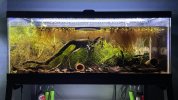
The image called "blackwater" is what the tank looks like now. I keep labyrinth fish in it, but it would work for dwarf cichlids becase the plants are grown in enough to completely block line of sight between different regions of the tank.
 

Attachments

  • apisto.jpg
    apisto.jpg
    2.1 MB · Views: 114
  • blackwater.jpg
    blackwater.jpg
    2.3 MB · Views: 113

Ben Rhau

Apisto Club
5 Year Member
Messages
699
Location
San Francisco
I have a lot susswassertang in these. The apisto tank had big clumps of it in the back and one in the front on the ride side. It's pretty effective at blocking lines of sight. In the blackwater tank, it filled up the entire area below the spider wood.
 
  • Like
Reactions: bcs

bcs

New Member
Messages
16
I have a lot susswassertang in these. The apisto tank had big clumps of it in the back and one in the front on the ride side. It's pretty effective at blocking lines of sight. In the blackwater tank, it filled up the entire area below the spider wood.
So just more structure. Will likely divide with rocks or whatever wood I can find
 

bcs

New Member
Messages
16
Hopefully this improves things. Sorry about the picture quality. I removed both the male and the female, added a large piece of mopani driftwood, and am planning on getting some nice oak leaves (large) for cover in the next day or so. Maybe also some magnolia. The tank is now very divided down the middle
 

Attachments

  • IMG_9318.jpeg
    3.8 MB · Views: 108
  • IMG_9317.jpeg
    4.2 MB · Views: 101
  • IMG_9316.jpeg
    4.9 MB · Views: 100

Ben Rhau

Apisto Club
5 Year Member
Messages
699
Location
San Francisco
The structure looks better to me for sure. It's hard to tell how bright it is because I don't know the photo exposure, but I'm seeing algae growing on the substrate, which indicates an imbalance. You could reduce the light to address that, I keep mine really low.

That said, large rosettes of water lettuce like you have need a lot of light, so I'm not sure how well it will do in a low energy setup. Others on this forum have kept large water lettuce with success, but not me. There was a picture (I can't find now) where the tank was open at the top with a bright light from above, but a dense enough mat of water lettuce to shade the water below.
 

Members online

No members online now.

Forum statistics

Threads
18,703
Messages
124,172
Members
13,589
Latest member
rozyjuise

Latest profile posts

Platforma SaldeoSMART automatyzuje obieg dokumentów i odczyt faktur (OCR) w firmach oraz biurach rachunkowych. System jest gotowy na zmiany prawne, a integracja z ksef pozwala na bezpieczne wysyłanie i odbieranie e-faktur ustrukturyzowanych.
dimandobson wrote on Ben Bergman's profile.
Hi Bergman. I have a pair of breeding dwarf cichlid for sale. if you are still looking, drop me your whatsapp number and i will send some videos to your whatsapp
Good-backlink.com - Professional website promotion, get more traffic to your website and improve ranking by using high PR link building service.
martin_c wrote on illumnae's profile.
Hi,

just in case you happen to live in Germany (or Netherlands): I have a wildcaught female A. psammophila, you could have it for free. I have no use for it anymore.

BR
Martin
Top