• Hello guest! Are you an Apistogramma enthusiast? If so we invite you to join our community and see what it has to offer. Our site is specifically designed for you and it's a great place for Apisto enthusiasts to meet online. Once you join you'll be able to post messages, upload pictures of your fish and tanks and have a great time with other Apisto enthusiasts. Sign up today!

First-time Apistogramma cacatuoides keeper - Is my small ( 30L ) tank adequate?

Ben Rhau

Apisto Club
5 Year Member
Messages
699
Location
San Francisco
you mean to choose the young male with a more balanced personality to avoid him constantly to chase the female?
No. What I'm saying is that unless you separate the mother from the juveniles, eventually she will breed with them. I mentioned this as a reason you need multiple tanks to limit breeding. Once the female starts to chase away the offspring, you should separate them.

How many same parents generations could be bread safely without imbreeding issues?
It is possible to go several generations. If you buy a pair from the same seller, they are likely siblings.
 

Apistonaut

Member
Messages
73
Location
Minnesota, US
Entirely with Ben. I've bred a few generations of Panduro now, from F1 siblings to F3.
Since those have wild genotypes, they are pretty resilient to 5-7+ generations of inbreeding without issues. I select for individuals who put on bulk quicker than their peers and exhibit typical wild patterns. Sometimes water quality can affect aspects of development, including sex and stunting (from temperature and nitrogen respectfully).

I struggled with nitrogen in a 20 gallon, so I have concerns with your ~10 gallon. With 50+ fry from a single clutch, I was soon generating about +10ppm nitrate a day from live foods. This required daily 25-50% water changes with RO to keep total nitrate under 5ppm and TDS well under 10-20. pH sat around 6.4-6.7.
Your aqua soil isn't a major concern for me. It's not ideal, but I've used it to maintain lightly acidic water. It's helpful in the sense that it pulls carbonates out of the water well, and pH swings are an inevitability if you are relying on water changes at frequencies like mine, anyway. Sand promotes more natural behavior in juveniles and adults, but they sift through soil pellets nonetheless in my experience.

You simply need more tanks if you want to breed. Ultimately I'd suggest returning the female and adding some more leaves and stem coverage for the male.

Since your A. Cacatuoides likely come from a farm, it might be best just to stick with the single clutch, consider returning the parents eventually, and selecting your favorite ones from the clutch as you raise them. Sell the rest back or gift some to friends.

Even if they are not line-bred, they still likely come from a very small pool of genes, whether from local breeders or not.
 
Last edited:

shamedonor

Member
Messages
60
Entirely with Ben. I've bred a few generations of Panduro now, from F1 siblings to F3.
Since those have wild genotypes, they are pretty resilient to 5-7+ generations of inbreeding without issues. I select for individuals who put on bulk quicker than their peers and exhibit typical wild patterns. Sometimes water quality can affect aspects of development, including sex and stunting (from temperature and nitrogen respectfully).

I struggled with nitrogen in a 20 gallon, so I have concerns with your ~10 gallon. With 50+ fry from a single clutch, I was soon generating about +10ppm nitrate a day from live foods. This required daily 25-50% water changes with RO to keep total nitrate under 5ppm and TDS well under 10-20. pH sat around 6.4-6.7.
Your aqua soil isn't a major concern for me. It's not ideal, but I've used it to maintain lightly acidic water. It's helpful in the sense that it pulls carbonates out of the water well, and pH swings are an inevitability if you are relying on water changes at frequencies like mine, anyway. Sand promotes more natural behavior in juveniles and adults, but they sift through soil pellets nonetheless in my experience.

You simply need more tanks if you want to breed. Ultimately I'd suggest returning the female and adding some more leaves and stem coverage for the male.

Since your A. Cacatuoides likely come from a farm, it might be best just to stick with the single clutch, consider returning the parents eventually, and selecting your favorite ones from the clutch as you raise them. Sell the rest back or gift some to friends.

Even if they are not line-bred, they still likely come from a very small pool of genes, whether from local breeders or not.
Thank you. Just wanted to apologize for my intervention into the Cagri`s topic. He asked about his small 8g set up for A. Cackatoo and received some comments on a possible aggression so I added my real recent story (as our set ups are similar in size) and some questions about possible options so it might be confusing what is going on and where :) As far I understand Cagri (Author) has no fry yet. The male agression toward a female on guard of its fry is my issue. I moved the male hoping it is temporarily.
 

Apistonaut

Member
Messages
73
Location
Minnesota, US
Thank you. Just wanted to apologize for my intervention into the Cagri`s topic. He asked about his small 8g set up for A. Cackatoo and received some comments on a possible aggression so I added my real recent story (as our set ups are similar in size) and some questions about possible options so it might be confusing what is going on and where :) As far I understand Cagri (Author) has no fry yet. The male agression toward a female on guard of its fry is my issue. I moved the male hoping it is temporarily.
All information to whoever it applies! Nothing directed at you or Cagri specifically! :)
No apologies needed, we are here for hobby, not filing taxes.

If able, prepare to remove the female in 2-4 weeks. She will first become disinterested in the fry after some time, and then will express aggression. It's best to remove her as soon as she is not herding the clutch, usually at that 3 week point.

Happy Holidays
 

shamedonor

Member
Messages
60
Entirely with Ben. I've bred a few generations of Panduro now, from F1 siblings to F3.
Since those have wild genotypes, they are pretty resilient to 5-7+ generations of inbreeding without issues. I select for individuals who put on bulk quicker than their peers and exhibit typical wild patterns. Sometimes water quality can affect aspects of development, including sex and stunting (from temperature and nitrogen respectfully).
I found wild guys are much more vulnerable to stress factors. I recently lost one more wild panduro male who jumped out into a small crack between the filter and the lid. He was simply scared to death meanwhile the tank bread female was almost OK at the same time, just lost some colors for a day. I just removed floating plants as found some pests on them so wanted to clean water ring/surface and replace the plants in a week or two and it was enough for the male to suicide. And that is no the first wild panduro stress jumper. I came to a conclusion that either next one will be tank raised or the tank needs to be completely established before I add a next wild one.
 

Apistonaut

Member
Messages
73
Location
Minnesota, US
I found wild guys are much more vulnerable to stress factors. I recently lost one more wild panduro male who jumped out into a small crack between the filter and the lid. He was simply scared to death meanwhile the tank bread female was almost OK at the same time, just lost some colors for a day. I just removed floating plants as found some pests on them so wanted to clean water ring/surface and replace the plants in a week or two and it was enough for the male to suicide. And that is no the first wild panduro stress jumper. I came to a conclusion that either next one will be tank raised or the tank needs to be completely established before I add a next wild one.
Sorry to hear that! Wild cichlids tend to explore more than tank bred ones (my guess). For example, wild German Rams (hard to find) are generally healthier and more tolerant than bright line bred Rams like at your lfs. They can thrive at mid to high 70s, even at a slightly higher pH and hardness.


Farmed fish bred in hard water often develop wider tolerances, especially if raised there from fry. Shiny line bred fish (like electric rams or super orange macmasteri) often have tight tolerances because selection favors color and finnage over hardiness.


For Apistogramma jumpers, recreating their natural environment helps. I just add almond leaves, alder cones, branches, and stem plants, dim the lighting, and tint the water. I wouldn't worry too much about disrupting their meditation, haha!
 

shamedonor

Member
Messages
60
All information to whoever it applies! Nothing directed at you or Cagri specifically! :)
No apologies needed, we are here for hobby, not filing taxes.

If able, prepare to remove the female in 2-4 weeks. She will first become disinterested in the fry after some time, and then will express aggression. It's best to remove her as soon as she is not herding the clutch, usually at that 3 week point.

Happy Holidays
I saw the fry for the very first time november 22 so that is already 5th week. I`d say she is no longer carrying of the fry but no aggression noticed on today. Yeah I wanna move her to the community tank and see how they go there together with the male and other fish mates (I do have spare tanks and equipment though, just need to finish some basement work to be able to install a bigger shelf to avoid to have tanks everywhere). My really key project is ivanacara adoketa. I'm currently looking for a female. Those will have everything they need :)

Happy Holydays as well!
 

shamedonor

Member
Messages
60
Sorry to hear that! Wild cichlids tend to explore more than tank bred ones (my guess). For example, wild German Rams (hard to find) are generally healthier and more tolerant than bright line bred Rams like at your lfs. They can thrive at mid to high 70s, even at a slightly higher pH and hardness.


Farmed fish bred in hard water often develop wider tolerances, especially if raised there from fry. Shiny line bred fish (like electric rams or super orange macmasteri) often have tight tolerances because selection favors color and finnage over hardiness.


For Apistogramma jumpers, recreating their natural environment helps. I just add almond leaves, alder cones, branches, and stem plants, dim the lighting, and tint the water. I wouldn't worry too much about disrupting their meditation, haha!
But imagine, I lost (shame to me) all 3 wild ones via jumping. First one because I did not have a lid and I moved them from quarantine to permanent tank. I said ok, it happens. The second one jumped I think because was stressed of the other one (he/she was smaller) when I forgot to put the lid back. Then everything was ok during a couple of month, last one even tried to spawn with a girl and now this **** because of the removed floating plants. I was never so unlucky with any other species. Whole wild butch gone because of my errors which cost them their life
 

anewbie

Well-Known Member
5 Year Member
Messages
2,702
There is one very expensive fish that you can keep in an 8 gallon -
Apistogrammoides pucallpaensis
You can read about it here:

wc specimen will do ok in 120-140 tds water (maybe harder never tested). You can try borelli though the females sometime go balistic which result in a dead male or a single male.
 

Abeythefishman

New Member
Messages
26
Where to begin... And please don't take it personal I'm trying to be on point. 30 liters are ok for breeding if you have the option to remove one of the fish at any point.

The substrate is less than ideal, fine sand is the substrate of choice for any dwarf cichlids and soil unless used with RO water (KH under 2 degrees) you will have constant pH shifts.

The tank is also not structured well. Apistos do not need caves for anything but breeding, they often avoid them in fear of predators that might lurk in them.

All in all: If getting a bigger tank or a second one isn't an option I would return them and get a single A. borellii. That will work fine in that tank.


Of course. He wants to sell you something. And he knows that at one point aggression wir bensonhigh one of the fish dies and you will need a replacement. Please keep that always in mind. I rarely trust store clerks unless I know they argue for the fishes wellbeing and not their profits.tank would help but given

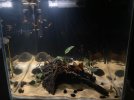
Hello everyone, This is my first post here, so please forgive me if I make any mistakes with formatting or language. I recently started keeping a pair of Apistogramma cacatuoides in a spare 30-liter (approximately 8-gallon) tank I had at home, following a friend's recommendation. The owner of my local aquarium store assured me this tank size would be sufficient for them.
Current Setup:
Tank: 30 liters / ~8 gallons
Substrate: Chihiros soil
Hardscape: 2 ceramic cylinder caves, 1 coconut cave, small mangrove wood pieces
Botanicals: Alder cones and Indian almond leaves (catappa)
Plants: Christmas moss and a small portion of Rotala (visible in the attached photo)
Filter: Eheim Liberty 200
Temperature: Stable at 25°C (77°F)
Water changes: 10% every 2-3 days, using 50% RO water for each change
Food: Tetra Cichlid Mini Granules and Tropical Softline America

Both fish appear to be in good health - they're very active, social, and have excellent appetites.

I understand that a larger tank would be ideal, but I'm wondering if I can continue keeping them under these conditions? Unfortunately, upgrading to a larger tank isn't an option for me at the moment. If keeping them in this setup poses significant risks to their wellbeing, I'm willing to return them to the store. I've grown quite attached to them and would love to continue caring for them, but only if it's appropriate.Since I'm completely new to this species, I would greatly appreciate any advice, suggestions, or feedback you might have regarding my setup and care routine.Thank you in advance for your help!

Note: I have had them for about one week.
Add as many plants as possible. Maybe get a terrestrial plant like a monstera of something like that. Wash all the roots and stick the roots in the tank. That will help kepvthecwater free if some of the bad stuff. If/when they breed you could remove the fry with a turkey baster and keep them in the same tank, in one if those a small plastic breeder devices they have on Amazon. Drop in baby brine shrimp…stand back and watch them grow!…..not sure what you do when they get a big bigger but I’m pretty sure they’ll need another tank…..
Btw…I’ve always found that a bigger tank is MUCH easier to keep than a small one I rarely do anything to my 60 gallon other than top up the water when it evaporates. I have terrestrial tropical plants in there and I’m sure they’ll help a lot.
Good luck..
 

Mike Wise

Moderator
Staff member
5 Year Member
Messages
11,869
Location
Denver, Colorado, U.S.A.
If/when they breed you could remove the fry with a turkey baster and keep them in the same tank, in one if those a small plastic breeder devices they have on Amazon. Drop in baby brine shrimp…stand back and watch them grow!
Poor advice IMHO. Fry feed and grow much better under the care of their mother.
…..not sure what you do when they get a big bigger but I’m pretty sure they’ll need another tank…..
Exactly
I rarely do anything to my 60 gallon other than top up the water when it evaporates.
Again, poor advice IMHO. Topping off a tank only concentrates the pollutants and water hardness.
I have terrestrial tropical plants in there and I’m sure they’ll help a lot.
This I accept if only the roots are in the tank, sort of like hydroponic gardening.
 

Cagri

New Member
Messages
10
Update: My Apistos Are Much Happier Now.
Just wanted to give you all a huge thank you! Your advice really helped me improve my Apistogramma setup.
Here's what I've done:
Upgraded to a 65L tank, changed to a pH-neutral substrate that's better suited for Apistos.
10 new tank mates ( ember tetra )
Attaching a pic of the updated tank. Thanks again, everyone! The fish seem so much more comfortable now :)
 

Attachments

  • IMG-20260104-WA0001.jpg
    IMG-20260104-WA0001.jpg
    257.9 KB · Views: 103
Last edited:

MacZ

Well-Known Member
5 Year Member
Messages
4,323
Location
Germany
No offence, but there is a lot of room for improvement. Better than before: Yes. Ideal: long way to go.

My first thought was: I've seen sale tanks in stores with more cover and plants than your tank. I hope you don't take this personal.

I'd add much more hardscape, especially more wood and lots of leaf litter. And just stuff that tank with plants.

You will need the plants, because they balance out the higher bioload.
 

Cagri

New Member
Messages
10
Hello,
I know that everything you've written is intended to help me, and I sincerely appreciate it. All of your input is incredibly valuable to me.
If I need to take this step by step, could you be a bit more specific about what I should do to successfully breed them and encourage natural behavior in my fish?
Here are my specific questions. I'm planning to add more Indian almond leaves and alder cones - how much would you recommend?
Considering I'm using sand (not soil), which plant species would you recommend and approximately how many should I add?
Are the Ember Tetras I added as dithers appropriate and sufficient for this purpose?
I know I'm asking quite a few questions, but I'm still a beginner in this area. Thank you in advance for your responses!
 

anewbie

Well-Known Member
5 Year Member
Messages
2,702
I would personally add another piece of wood down the center or in the back side that is large enough to block their view and i would add some nice leaves that are 4 inches or so across - large enough that they can hide under. Other than that the only other real magic is super soft warm acidic water and patience.

Of course the negative of adding too much is then you can't find the bloody fishes for weeks or months at a time ;)

i have at least one fish i haven't seen in 6 months and two i saw the other day for the first time in 9 months.
 

MacZ

Well-Known Member
5 Year Member
Messages
4,323
Location
Germany
If I need to take this step by step, could you be a bit more specific about what I should do to successfully breed them and encourage natural behavior in my fish?
Breeding comes automatically with good holding conditions. I have no specific "do x and they will successfully breed"-hint for you. I also already told you, breeding is not going to work successfully unless you get at least one more tank.

Here are my specific questions. I'm planning to add more Indian almond leaves and alder cones - how much would you recommend?
Stick to leaf litter. And as your tank is very small: Only ad a few at once. Dead plant material starts to decompose from the moment you submerge it. And within the first 24 hours the stuff is colonized by microbes. This colonization takes oxigen and accordingly too much material added at the same time might cause an oxygen depletion, putting your fish in danger.

I always use alder cones only to make humic extract (basically a tannin tea) which I then add to the tank. You can dry and reuse cones up to 3 times in between brews. The cones often still contain seeds and those rot faster and more aggressively than the other dead plant material as they contain much more nutrients.

Considering I'm using sand (not soil), which plant species would you recommend and approximately how many should I add?
Knock youself out with whatever standards you find in your local store. I rarely had a plant not growing on sand. I started fishkeeping before the industry started making everybody think you need soil, a sophisticated fertilizer schedule and CO2 injection to grow plants. My personal favourites: Nymphaea, Bacopa, Alternanthera, Limnobium (floater), Phyllanthus (floater), Salvina (floater) and all sorts of mosses and epiphytes.

When it comes to amounts: Nymphaea will try to block out light with floating leaves so 1-2 are enough. Stemplants like Bacopa: A many as you think you can fit in and then double the amount. Floaters should be added in a good portion, they will compete with each other so expect one or two species to die out at one point.

Are the Ember Tetras I added as dithers appropriate and sufficient for this purpose?
There is no need for dithers, especially not in such a small tank. I'll put it this way: Once the tetras have reached adult size your tank is overstocked in terms of bioload and overcrowded as well.

Other than that the only other real magic is super soft warm acidic water and patience.
Warm is probably a bit misleading. The tetras can go down to 17°C easily and the Apistos here will be fine between 24 and 26.
 

anewbie

Well-Known Member
5 Year Member
Messages
2,702
You want to focus on plants that prefer soft water as hardwater plants or plants with hard water preference won't do very well. Yes plants like fishes have preferences based on native habitat for water hardness. The easiest way to determine if a specific species wants hard or soft water is to google it ;)
-
Most common plants can handle a variety of water parameters BUT since in theory you should move to the extreme end towards blackwater some common plants will struggle. I personally do not like dwarf lilly because they become a pain in the ass to manage - i'd go with some of the interesting echinodorus with big bear being an easy to grow plant that will get fairly large and (in my opinion) is a bit more interesting in structure and colour than amazon sword. I also like val nana daily and their variety as they are very thin leave but still grow quite well. Frogbit on the surface is my preference though others have other preference. green or green greco wenditti is also a favorite as well as beckettii and one or two c. balansae (in the back as they get quite tall but not dense). crypt spiralis (there are several red varieties) can grow but it will struggle a bit more over long period and root tabs will help a little.
 

shamedonor

Member
Messages
60
My personal favourites: Nymphaea, Bacopa, Alternanthera, Limnobium (floater), Phyllanthus (floater), Salvina (floater) and all sorts of mosses and epiphytes.
sorry for kinda off topic... you said alternathera is good... what precisely specious do you mean for a soft water acidic breeding tank? I have an alternathera reinekii red and it has algae problems even in a co2 injected fertilized tank. I put a cutting of it into another tap water community tank and it is nearly not growing in there.
 

MacZ

Well-Known Member
5 Year Member
Messages
4,323
Location
Germany
Classic Alternanthera reineckii. I never had any problems with the plant genera I listed and never used CO2 injection. If any I used a liquid makro&mikro nutrient fertilizer comparable to the green Tropica specialized, and that's it. The water usually was pure RO. Algae come and go in my opinion and also if a plant species dies out in a tank due to competirion, it wasn't meant to be.

Otherwise here for you my list of species from the mentioned genera:
Nymphaea lotus
Bacopa carolinea
Alternanthera reineckii
Limnobium laevigatum
Phyllanthus fluitans
Salvinia auriculata
 

Cagri

New Member
Messages
10
Breeding comes automatically with good holding conditions. I have no specific "do x and they will successfully breed"-hint for you. I also already told you, breeding is not going to work successfully unless you get at least one more tank.


Stick to leaf litter. And as your tank is very small: Only ad a few at once. Dead plant material starts to decompose from the moment you submerge it. And within the first 24 hours the stuff is colonized by microbes. This colonization takes oxigen and accordingly too much material added at the same time might cause an oxygen depletion, putting your fish in danger.

I always use alder cones only to make humic extract (basically a tannin tea) which I then add to the tank. You can dry and reuse cones up to 3 times in between brews. The cones often still contain seeds and those rot faster and more aggressively than the other dead plant material as they contain much more nutrients.


Knock youself out with whatever standards you find in your local store. I rarely had a plant not growing on sand. I started fishkeeping before the industry started making everybody think you need soil, a sophisticated fertilizer schedule and CO2 injection to grow plants. My personal favourites: Nymphaea, Bacopa, Alternanthera, Limnobium (floater), Phyllanthus (floater), Salvina (floater) and all sorts of mosses and epiphytes.

When it comes to amounts: Nymphaea will try to block out light with floating leaves so 1-2 are enough. Stemplants like Bacopa: A many as you think you can fit in and then double the amount. Floaters should be added in a good portion, they will compete with each other so expect one or two species to die out at one point.


There is no need for dithers, especially not in such a small tank. I'll put it this way: Once the tetras have reached adult size your tank is overstocked in terms of bioload and overcrowded as well.


Warm is probably a bit misleading. The tetras can go down to 17°C easily and the Apistos here will be fine between 24 and 26.
Thank you very much for the information you provided. I think the first thing I need to do is upgrade to an even larger aquarium. I currently have another 90-liter aquarium where I keep ramirezi and galaxy rasboras. I think it would make more sense to rehome the fish in that tank and move the apistogrammas there.
You want to focus on plants that prefer soft water as hardwater plants or plants with hard water preference won't do very well. Yes plants like fishes have preferences based on native habitat for water hardness. The easiest way to determine if a specific species wants hard or soft water is to google it ;)
-
Most common plants can handle a variety of water parameters BUT since in theory you should move to the extreme end towards blackwater some common plants will struggle. I personally do not like dwarf lilly because they become a pain in the ass to manage - i'd go with some of the interesting echinodorus with big bear being an easy to grow plant that will get fairly large and (in my opinion) is a bit more interesting in structure and colour than amazon sword. I also like val nana daily and their variety as they are very thin leave but still grow quite well. Frogbit on the surface is my preference though others have other preference. green or green greco wenditti is also a favorite as well as beckettii and one or two c. balansae (in the back as they get quite tall but not dense). crypt spiralis (there are several red varieties) can grow but it will struggle a bit more over long period and root tabs will help a little.
I think I'll need to upgrade the aquarium before adding more plants, so for now it would make more sense to keep it limited to a few buce, java fern and anubias, and start planting in the new aquarium. Thank you for your response.
 

Members online

Forum statistics

Threads
18,703
Messages
124,172
Members
13,589
Latest member
rozyjuise

Latest profile posts

Platforma SaldeoSMART automatyzuje obieg dokumentów i odczyt faktur (OCR) w firmach oraz biurach rachunkowych. System jest gotowy na zmiany prawne, a integracja z ksef pozwala na bezpieczne wysyłanie i odbieranie e-faktur ustrukturyzowanych.
dimandobson wrote on Ben Bergman's profile.
Hi Bergman. I have a pair of breeding dwarf cichlid for sale. if you are still looking, drop me your whatsapp number and i will send some videos to your whatsapp
Good-backlink.com - Professional website promotion, get more traffic to your website and improve ranking by using high PR link building service.
martin_c wrote on illumnae's profile.
Hi,

just in case you happen to live in Germany (or Netherlands): I have a wildcaught female A. psammophila, you could have it for free. I have no use for it anymore.

BR
Martin
Top