• Hello guest! Are you an Apistogramma enthusiast? If so we invite you to join our community and see what it has to offer. Our site is specifically designed for you and it's a great place for Apisto enthusiasts to meet online. Once you join you'll be able to post messages, upload pictures of your fish and tanks and have a great time with other Apisto enthusiasts. Sign up today!

First-time Apistogramma cacatuoides keeper - Is my small ( 30L ) tank adequate?

Cagri

New Member
Messages
10
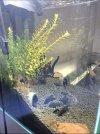
Hello everyone, This is my first post here, so please forgive me if I make any mistakes with formatting or language. I recently started keeping a pair of Apistogramma cacatuoides in a spare 30-liter (approximately 8-gallon) tank I had at home, following a friend's recommendation. The owner of my local aquarium store assured me this tank size would be sufficient for them.
Current Setup:
Tank: 30 liters / ~8 gallons
Substrate: Chihiros soil
Hardscape: 2 ceramic cylinder caves, 1 coconut cave, small mangrove wood pieces
Botanicals: Alder cones and Indian almond leaves (catappa)
Plants: Christmas moss and a small portion of Rotala (visible in the attached photo)
Filter: Eheim Liberty 200
Temperature: Stable at 25°C (77°F)
Water changes: 10% every 2-3 days, using 50% RO water for each change
Food: Tetra Cichlid Mini Granules and Tropical Softline America

Both fish appear to be in good health - they're very active, social, and have excellent appetites.

I understand that a larger tank would be ideal, but I'm wondering if I can continue keeping them under these conditions? Unfortunately, upgrading to a larger tank isn't an option for me at the moment. If keeping them in this setup poses significant risks to their wellbeing, I'm willing to return them to the store. I've grown quite attached to them and would love to continue caring for them, but only if it's appropriate.Since I'm completely new to this species, I would greatly appreciate any advice, suggestions, or feedback you might have regarding my setup and care routine.Thank you in advance for your help!

Note: I have had them for about one week.

 

Attachments

  • Screenshot_20251219_234221_Gallery.jpg
    Screenshot_20251219_234221_Gallery.jpg
    1.2 MB · Views: 176
  • Screenshot_20251219_234203_Gallery.jpg
    Screenshot_20251219_234203_Gallery.jpg
    1.1 MB · Views: 175
  • Screenshot_20251219_234138_Gallery.jpg
    Screenshot_20251219_234138_Gallery.jpg
    1.2 MB · Views: 185
  • Screenshot_20251219_234124_Gallery.jpg
    Screenshot_20251219_234124_Gallery.jpg
    1.2 MB · Views: 177
  • Screenshot_20251219_234047_Gallery.jpg
    Screenshot_20251219_234047_Gallery.jpg
    1.2 MB · Views: 184

MacZ

Well-Known Member
5 Year Member
Messages
4,323
Location
Germany
Where to begin... And please don't take it personal I'm trying to be on point. 30 liters are ok for breeding if you have the option to remove one of the fish at any point.

The substrate is less than ideal, fine sand is the substrate of choice for any dwarf cichlids and soil unless used with RO water (KH under 2 degrees) you will have constant pH shifts.

The tank is also not structured well. Apistos do not need caves for anything but breeding, they often avoid them in fear of predators that might lurk in them.

All in all: If getting a bigger tank or a second one isn't an option I would return them and get a single A. borellii. That will work fine in that tank.


The owner of my local aquarium store assured me this tank size would be sufficient for them.
Of course. He wants to sell you something. And he knows that at one point aggression wir bensonhigh one of the fish dies and you will need a replacement. Please keep that always in mind. I rarely trust store clerks unless I know they argue for the fishes wellbeing and not their profits.
 

shamedonor

Member
Messages
60
I have an a. Cacatuoide breeding pair in a 10gal. First they were swimming peacefully, got their first fry, the female was with the fry. She sometimes gently pushed the male with her mouth when he was in her opinion too close to the fry and he went away like a poor guy whose wife set him out. One morning something changed in his small fish brain and he started to chase her everywhere. At the point that she left her fry and was hiding in the cave where he was following her. Don't know what did he do to her in there but in the end of the day I just moved him to a community tank. Now the female is okay with her fry. But this being said that in such a small tank if one fish gets aggressive another one has no way to escape
 

anewbie

Well-Known Member
5 Year Member
Messages
2,702
At the point that she left her fry and was hiding in the cave where he was following her. Don't know what did he do to her in there but in the end of the day I just moved him to a community tank. Now the female is okay with her fry. But this being said that in such a small tank if one fish gets aggressive another one has no way to escape
He wants to breed again and she does not as she has frys under her care. This is normal behavior and the reason why a small tank is bad for such fishes unless you can separate the male as you did ;)
 

shamedonor

Member
Messages
60
He wants to breed again and she does not as she has frys under her care. This is normal behavior and the reason why a small tank is bad for such fishes unless you can separate the male as you did ;)
So my guessing was correct lol
I accepted this risk as i do have another aquariums to move one fish. Now I think I will move both to a bigger comunity tank to live together and watch after them.
What does usually follow such breeding insisting attempts? Would she leave the fry and accept him or otherwise could be stressed to death? I also now have less fry, could them be eaten by him? I never saw him being aggressive toward the fry
 

anewbie

Well-Known Member
5 Year Member
Messages
2,702
So my guessing was correct lol
I accepted this risk as i do have another aquariums to move one fish. Now I think I will move both to a bigger comunity tank to live together and watch after them.
What does usually follow such breeding insisting attempts? Would she leave the fry and accept him or otherwise could be stressed to death? I also now have less fry, could them be eaten by him? I never saw him being aggressive toward the fry
usually death.
 

MacZ

Well-Known Member
5 Year Member
Messages
4,323
Location
Germany
Stress from negative social interaction causes high vulnerability to infections and for latent parasites to take over. The immune system collapses basically. in my opinion the number one cause of death in captive dwarf cichlids and especially Apistogramma.

The "cycle" of agression in most of the polygamous species* goes like this: If the female isn't receptive to spawning the male will harrass her to death, direkt killings are possible but not the norm. But once they have spawned, the females become super aggressive and not only push away the male (which might succumb to stress related issues) but every fish coming too close to her cave/fry. I've seen a small 5cm Apisto female keeping the stock of a whole 120cm community tank in check, pushing tetras, otos and the male Apistogramma in one third of the tank. In smaller tanks beat up males are quite common. That's why you remove the male after spawning if you breed in a system with small tanks.

* The only group of Apistos that regularly stay monogamous are from the A. nijsseni species group (e.g. A. nijsseni, A. panduro, A. baenschi).

Addendum: Besides the Nijsseni A. borellii is a complete outlier, they are polygamous, but not even closely as aggressive as any other species.
 

illumnae

Active Member
5 Year Member
Messages
149
Slightly off tangent question here, but does the monogamy give the male greater parental instincts than typical polygamous apistos? I have noticed my A rositae male helping to guard the fry and he has not been harassing the female to breed even a couple of weeks after the fry hatched. As of today he's still threat displaying against the A uaupesi in the adjacent tank when he usually ignored them pre-spawn.
 

MacZ

Well-Known Member
5 Year Member
Messages
4,323
Location
Germany
That seems to be an individual thing. I have seen very different levels of participation within the same species.
 

anewbie

Well-Known Member
5 Year Member
Messages
2,702
Slightly off tangent question here, but does the monogamy give the male greater parental instincts than typical polygamous apistos? I have noticed my A rositae male helping to guard the fry and he has not been harassing the female to breed even a couple of weeks after the fry hatched. As of today he's still threat displaying against the A uaupesi in the adjacent tank when he usually ignored them pre-spawn.
As mac said high variance. I've had cockatoo male care for frys as well as ortega and my male nijjensi didn't give a hoot about the frys while the female tended them.

The nijjensi and ortegai were wc while the cockatoo was domestic.
 

shamedonor

Member
Messages
60
The "cycle" of agression in most of the polygamous species* goes like this: If the female isn't receptive to spawning the male will harrass her to death, direkt killings are possible but not the norm. But once they have spawned, the females become super aggressive and not only push away the male (which might succumb to stress related issues) but every fish coming too close to her cave/fry..
Do you think it is a good idea/safe to put that a. cackatoo female into the 45gal community tank where her male already is once she stops to care of the fry (1 month old)? There is a young angel (sometimes lightly chased by the cackatoo male), few danios and I'm planning to aide more very young angels (really small). I mean I do not plan to breed them in there but just to provide them a good environment to live in until I breed them again in a smaller tank like before or move away if needed and if other fish eat the fry I accept that for now. Just want the female to be safe from the male's harassment.
* The only group of Apistos that regularly stay monogamous are from the A. nijsseni species group (e.g. A. nijsseni, A. panduro, A. baenschi).
It seems the panduro would be my best choice then as I don't want to set a dozen of tanks to be able to move the male every time they get fry
 

Ben Rhau

Apisto Club
5 Year Member
Messages
699
Location
San Francisco
What does usually follow such breeding insisting attempts? Would she leave the fry and accept him or otherwise could be stressed to death?
Both outcomes result in stress. The female may breed again immediately, but this is stressful because she has not fully recovered from the prior clutch. If you allow the female to breed repeatedly in rapid succession, she will burn out with lower life expectancy.

The other outcome is that she will not be ready to breed and the male will keep trying to chase her away to attract a more receptive female.
 

shamedonor

Member
Messages
60
Both outcomes result in stress. The female may breed again immediately, but this is stressful because she has not fully recovered from the prior clutch. If you allow the female to breed repeatedly in rapid succession, she will burn out with lower life expectancy.

The other outcome is that she will not be ready to breed and the male will keep trying to chase her away to attract a more receptive female.
Does all this mean that my issue is a too hot male and no matter where do I put them (smaller dedicated tank or a bigger community fry unfriendly one) he will repeatedly chase her until she dies and I should look for another male?
 

Ben Rhau

Apisto Club
5 Year Member
Messages
699
Location
San Francisco
Does all this mean that my issue is a too hot male and no matter where do I put them (smaller dedicated tank or a bigger community fry unfriendly one) he will repeatedly chase her until she dies and I should look for another male?
No, I'm saying this is the normal behavior for males of the polygamous species. They will always want to breed.
 

Ben Rhau

Apisto Club
5 Year Member
Messages
699
Location
San Francisco
I mean I do not plan to breed them in there but just to provide them a good environment to live in until I breed them again in a smaller tank like before or move away if needed and if other fish eat the fry I accept that for now.
The fish do not care that you "do not plan to breed them in there." If you put a female and male together, they will usually try to breed.

It seems the panduro would be my best choice then as I don't want to set a dozen of tanks to be able to move the male every time they get fry
You only need one other tank to separate the male, not dozens.

Panduro are not truly monogamous, but tend to stay together for at least one breeding cycle. Unlike with polygamous species, the pair are not guaranteed to be compatible. So you may need to try one or more than one combination of male/female.
 

shamedonor

Member
Messages
60
The fish do not care that you "do not plan to breed them in there." If you put a female and male together, they will usually try to breed.


You only need one other tank to separate the male, not dozens.
I mean if I have a couple of apisto species (cackatoo and panduro) I automatically need 4 tanks to move males any moment he becomes aggressive. The idea was to breed one-two fish species by a time so other ones could stay in a bigger community tank. I saw people successfully to keep cackatoo in community tanks but honestly I'm confused. If their behavior doesn't "pacificate" in such an environment how do I organize their live them both to be safe?
 

Ben Rhau

Apisto Club
5 Year Member
Messages
699
Location
San Francisco
The issue is not that the male is "too aggressive." The issue is that these fish breed very easily, and it's good to be able to control how often they breed for practical reasons, and for the fishes' well being.

My advice:
  1. Cichlids are aggressive fish. If you want to keep aggressive fish, you should have the means to separate them when necessary.
  2. If you truly want to breed, you cannot avoid having multiple tanks for breeding, separation, and growout.
Yes, some people do keep pairs in community tanks. The most active posters in this forum don't recommend doing that, because there are many variables that can generate stress for everyone in the tank.

If their behavior doesn't "pacificate" in such an environment how do I organize their live them both to be safe?
To keep everyone safe, you can try to avoid situations that invite conflict. Then you observe the fish, and when conflict arises, you intervene before too much damage is done.
 

shamedonor

Member
Messages
60
The issue is not that the male is "too aggressive." The issue is that these fish breed very easily, and it's good to be able to control how often they breed for practical reasons, and for the fishes' well being.

My advice:
  1. Cichlids are aggressive fish. If you want to keep aggressive fish, you should have the means to separate them when necessary.
  2. If you truly want to breed, you cannot avoid having multiple tanks for breeding, separation, and growout.
Yes, some people do keep pairs in community tanks. The most active posters in this forum don't recommend doing that, because there are many variables that can generate stress for everyone in the tank.


To keep everyone safe, you can try to avoid situations that invite conflict. Then you observe the fish, and when conflict arises, you intervene before too much damage is done.
Thank you!
The original idea was, as I said before, to breed one or two species at a time simply to reduce tank number/space and maintenance needed to keep everything in good shape. Sure it takes a number of compatible community and dedicated tanks but though it is less then all at a time. But now it seems to be a not too realistic plan :) The breeding for me is rather an experience, nature observation and better understanding.
 

Ben Rhau

Apisto Club
5 Year Member
Messages
699
Location
San Francisco
For a single species, you realistically need 3 tanks if you want to fry to grow to maturity. Even if you don't intend to raise them, a handful of fry will survive, and eventually they can breed also. Typically, the female would breed with one of her offspring. So you'll need to figure out which fish to keep in the tank and which fish to move.
 

shamedonor

Member
Messages
60
For a single species, you realistically need 3 tanks if you want to fry to grow to maturity. Even if you don't intend to raise them, a handful of fry will survive, and eventually they can breed also. Typically, the female would breed with one of her offspring. So you'll need to figure out which fish to keep in the tank and which fish to move.
you mean to choose the young male with a more balanced personality to avoid him constantly to chase the female? How many same parents generations could be bread safely without imbreeding issues? Need to aske the seller to make sure but it seems mine are already kind of siblings or so.
Sure I do have another small tank to put the fry in while they are big enough to go to the community or to be rehomed/sold etc
 

Members online

No members online now.

Forum statistics

Threads
18,703
Messages
124,172
Members
13,589
Latest member
rozyjuise

Latest profile posts

Platforma SaldeoSMART automatyzuje obieg dokumentów i odczyt faktur (OCR) w firmach oraz biurach rachunkowych. System jest gotowy na zmiany prawne, a integracja z ksef pozwala na bezpieczne wysyłanie i odbieranie e-faktur ustrukturyzowanych.
dimandobson wrote on Ben Bergman's profile.
Hi Bergman. I have a pair of breeding dwarf cichlid for sale. if you are still looking, drop me your whatsapp number and i will send some videos to your whatsapp
Good-backlink.com - Professional website promotion, get more traffic to your website and improve ranking by using high PR link building service.
martin_c wrote on illumnae's profile.
Hi,

just in case you happen to live in Germany (or Netherlands): I have a wildcaught female A. psammophila, you could have it for free. I have no use for it anymore.

BR
Martin
Top