• Hello guest! Are you an Apistogramma enthusiast? If so we invite you to join our community and see what it has to offer. Our site is specifically designed for you and it's a great place for Apisto enthusiasts to meet online. Once you join you'll be able to post messages, upload pictures of your fish and tanks and have a great time with other Apisto enthusiasts. Sign up today!

Questions regarding softwater tanks

Phil_1983

Member
Messages
87
Location
Germany, NRW
Hello Apistogramma Forum,

I’m new to the community here, although I was a silent reader a few years ago.

Due to various life circumstances, I had to put my aquarium hobby on hold for several years. Now I’m finally returning and have set up a 180-liter aquarium (100 × 40 × 50 cm), in which I plan to keep some tetras and a male Apistogramma. I haven’t decided on the species yet.

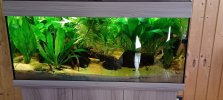
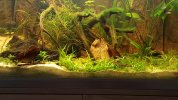
My main goal, however, is to finally realize a true soft-water aquarium. I have an RO unit available and some limited experience. In the past, I always slightly remineralized the water (to around 100 µS/cm) for the sake of the plants. Back then, these were not true biotope aquariums, although there was a certain “blackwater look.” I’m happy to attach a photo or two of what I used to do in the past.

At this stage, I’m mainly interested in how I should approach this project. I’ve already read that using a large amount of, for example, wood, botanicals, and leaf litter is an important first step toward aquarium stability. But what else needs to be considered? How many plants should be added? Floating plants—yes or better not? Should I use pure RO water (around 8 µS/cm), or should I remineralize it slightly again?

How do I achieve a deep brown water color? In the past, I used a product from the German company DRAK. Do I need any additional products to ensure the well-being of the fish?

So many questions. Please excuse such an introduction. I would still be very grateful for any help

Best regards,
Phil
 

Attachments

  • Aq1.jpeg
    Aq1.jpeg
    390.2 KB · Views: 98
  • Aq2.jpeg
    Aq2.jpeg
    191.9 KB · Views: 101

MacZ

Well-Known Member
5 Year Member
Messages
4,323
Location
Germany
Concerning plant choices: I've always worked with plants that cheat the low amounts of dissolved CO2 and the problem with lack of light. So basically I stick to floaters, floating leaves (Nymphaea sp., Nymphoides sp., Aponogeton sp.) and emersed plants like pothos or Monstera.

Water: I used pure RO, no remineralization, at best minimal fertilizer use (like 10-20ml liquid fertilizer per month) using the duckweed index.

About the colour: The lower the pH the lighter the water (just like with black tea and lemon juice). My tipp: Use a combo of rooibos tea and alder cones, make a tea-extract from that, let it cool, chugg it in.

Hope that helps.
 

Phil_1983

Member
Messages
87
Location
Germany, NRW
Thanks, that's helping a lot for now.

Just two more quick questions:
When you say tea-extract... What do you think how long I got to cook it? Really long to concentrate it or just a few minutes to sterilize?

And what kind of substrate would you recommend? I was going for fine silicate sand. Do you think this is appropiate?
 

MacZ

Well-Known Member
5 Year Member
Messages
4,323
Location
Germany
When you say tea-extract... What do you think how long I got to cook it? Really long to concentrate it or just a few minutes to sterilize?
You don't cook it. You put the stuff in a bowl or an other container and pour boiling water over, then let it steep. I usually used 2 liters of pure RO, 2-3 bags of rooibos and 10-20 small alder cones. Sometimes I added some pieces of catappa bark or leaves.

Sterilizing is not necessary. I mean, Rooibos is for human consumption (costs less than 0.25 € per teabag and alder cones ... why should terrestrial pathogens work underwater? They don't.

You can let the stuff steep either until its room temperature or until the next day. If you want to let it in for longer throw in an airstone, otherwise the microorganisms that settle on the botanicals use up the oxygen and different problems may arise from that.

And what kind of substrate would you recommend? I was going for fine silicate sand. Do you think this is appropiate?
Fine sand. Always. I used to do biotope tanks, so I tried to emulate the natural habitats.
 

MacZ

Well-Known Member
5 Year Member
Messages
4,323
Location
Germany
As visible in the picture there are aquatic plants nonetheless. In this case some kind of Nymphaea. The diversity of plants is also low. A few genera only.
True blackwater streams in Nature have very few submerged plants. Most are emergent or floating plants. This is an example of a typical (flowing) blackwater stream. (Who is that guy anyway?):)
View attachment 17437
 

Phil_1983

Member
Messages
87
Location
Germany, NRW
Thanks again.

One more question about the substrate.

If I use fine quartz sand (0.1–0.3 mm), how thick can the layer be? Do the leaves and botanicals need to be added in sufficient quantities to cover the entire substrate? How thick can or must this layer ultimately be?

I understand that the mulm that forms over time remains in the tank. Are there any exceptions to this rule?

Please excuse all these beginner questions.

Translated with DeepL.com (free version)
 

MacZ

Well-Known Member
5 Year Member
Messages
4,323
Location
Germany
If I use fine quartz sand (0.1–0.3 mm), how thick can the layer be?
3-4cm

Do the leaves and botanicals need to be added in sufficient quantities to cover the entire substrate?
Just add over time and keep the mulm layer growing. I put in about 5 leaves a week, every week. The only exception to this botanical mulm would be mulm from leftover food and feces. That would be detrimental. But if you keep the botanical mulm this is countered. Keep the stocking densitiy low and only feed as much as needed.

Just take footage of my last tank as a reference:


You don't remove anything, btw. Just let the stuff rot down to mulm.
 

Dwarf_Enthusiast

New Member
Messages
2
Location
Minnesota, USA
Little addition: you can reuse the alder cones. Dry them after the first brew, depending on quality 1-2 more brews are possible.
I collect local Alder cones, sterilize with an oven or food dehydrator, and toss them into all my soft water tanks. They are my favorite botanical because, in my experience, they last a very long time compared to leaves and they have always seemed to be a good home for the microfauna in my tanks. The advantage of using them as whole botanical instead of a "tea" is that they add a very naturalistic look, they are a great home for microfauna, they provide a lot of surface area for nitrifying bacteria to colonize, and you're likely to get a more "extended release" effect out of them.
 

MacZ

Well-Known Member
5 Year Member
Messages
4,323
Location
Germany
I've found them too much for my setup. If used in a tank the seeds should be shaken out of the cones, because those really tend to foul.

But as always with natural products: Mileage may vary.
 

Phil_1983

Member
Messages
87
Location
Germany, NRW
Since I am not a friend of wild caught fish in tanks, I ran into another question.
Do captive-bred fish have problems with soft water? And how would you go about introducing them? Drip method?

Not that it's relevant right now, but I'd rather find out in advance.
 

MacZ

Well-Known Member
5 Year Member
Messages
4,323
Location
Germany
Do captive-bred fish have problems with soft water?
Depends. While F-Generation fish (usually applied to up to 5 Generations removed from wild caught specimens) are often bred in softwater, they are in my experience hardier than domestic breeds dozens of generations (including line- and inbreeding) removed from their wild ancestors.

Interestingly the domestic breeds are often so inbred their general health and life expectancy are bad. ANd while they have often been bred for generations in tapwater, they do tend to do better in softwater. This is especially evident in colour breeds of M. ramirezi.

And how would you go about introducing them? Drip method?
I prefer drip method, but it definitely depends on the EC of the store/transport water and your tankwater. The higher the difference the more I advise to use drip acclimation.
 

Phil_1983

Member
Messages
87
Location
Germany, NRW
Hey Guys,
it's me again. Since I am going to setup the tank this weekend, I have one question about the "cycling"-phase.

How many and how much water changes would you do?
After "cycling" (let's say 4 weeks), what would be your recommondation for water changes? I am planning 50% per week. Do you think this is feasible or too much/less?
 

MacZ

Well-Known Member
5 Year Member
Messages
4,323
Location
Germany
50% per week are a good start. If you work with emersed plants (Epipremnum, Philodendron, Monstera) and floaters to remove thing like nitrates and keep the stocking density low it might take a year until you can phase out waterchanges to once every few months and instead just have to top off with RO water.
 

Members online

Forum statistics

Threads
18,704
Messages
124,175
Members
13,590
Latest member
jukaklimatyzacje

Latest profile posts

Platforma SaldeoSMART automatyzuje obieg dokumentów i odczyt faktur (OCR) w firmach oraz biurach rachunkowych. System jest gotowy na zmiany prawne, a integracja z ksef pozwala na bezpieczne wysyłanie i odbieranie e-faktur ustrukturyzowanych.
dimandobson wrote on Ben Bergman's profile.
Hi Bergman. I have a pair of breeding dwarf cichlid for sale. if you are still looking, drop me your whatsapp number and i will send some videos to your whatsapp
Good-backlink.com - Professional website promotion, get more traffic to your website and improve ranking by using high PR link building service.
martin_c wrote on illumnae's profile.
Hi,

just in case you happen to live in Germany (or Netherlands): I have a wildcaught female A. psammophila, you could have it for free. I have no use for it anymore.

BR
Martin
Top