• Hello guest! Are you an Apistogramma enthusiast? If so we invite you to join our community and see what it has to offer. Our site is specifically designed for you and it's a great place for Apisto enthusiasts to meet online. Once you join you'll be able to post messages, upload pictures of your fish and tanks and have a great time with other Apisto enthusiasts. Sign up today!

Panduro pairing wait or give up

shamedonor

Member
Messages
60
Hi. I have a bigger but young panduro male and a young smaller female. The male was introduced to the tank 2..3 weeks ago. The tank is a 20gal RO blackwater with wood, pines, leaves, plants and everything needed. According to the previous owner the male is wild but not 100% sure though Then as I was not able to find a female i introduced 6 harlequin rasbora to let them spawn as well. Last Friday (4 days ago) I found a smaller domestic f2 female. She was clearly female colored. The first evening the light was off. Next day I observed them periodically. There was almost no chasing. She found her a coconut cave. Day 2 or 3 I saw even the male entering her cave, staying in there 20-40sec, then leaving her. The female sometimes leves her cave and looked okay or even brilliant. Then the male started to chase her more often. Just chasing, no physical contact or damage. Now I'd say she looks more pale. She is still eating, exploring the tank, but I almost no longer see them interacting other than by chasing. She is escaping or avoiding him, and only sometimes he comes to the cave.
Water tds 50, conductivity 90, ph 6.4-6.6, temperature 77f.
Is there something I should do to encourage yhem to pair? When it's time to move to another female?
 

shamedonor

Member
Messages
60
Feed them up, perform a large water change?
Sure. Twice a day frozen brine shrimp or blood worms, yesterday a 50% ro water change and temp drop of 2f and tank rearranging. Before same feeding but smaller but frequent water change
 

MacZ

Well-Known Member
5 Year Member
Messages
4,323
Location
Germany
blood worms
Are considered problematic because there are many deaths connected to that stuff.

temp drop of 2f
We're talking Apistogramma, not Corydoras here. This will likely have no effect. Besides, if twmp is supposed to have an effect we're talking 5-6 °C (10-12°F) difference. 1°C is barely within accuracy of a standard analog thermometer.


tank rearranging.
Prolongs the time they need to really settle in. Counterproductive in my opion.
 

Mike Wise

Moderator
Staff member
5 Year Member
Messages
11,869
Location
Denver, Colorado, U.S.A.
Nijsseni-group species can be choosy about breeding partners. You new female's behavior indicates that breeding occurred but was unsuccessful. Now the male is looking for another breeding partner. You don't say what kind do 20 gallon tank that you have. I also don't understand why your "RO blackwater" tank has such a high conductivity. My compatible breeding pairs readily reproduced at pH ~6.0 and 35µS conductivity.
 

MacZ

Well-Known Member
5 Year Member
Messages
4,323
Location
Germany
I also don't understand why your "RO blackwater" tank has such a high conductivity
I agree. True softwater has a conductivity under 50µS/cm and no measurable GH and KH. The closest approximation to clear- and true blackwater in captivity is about 20-30µS/cm with a pH of around 5. Actual blackwater in nature is at a conductivity under 10! µS/cm with a pH below! 5.
 

shamedonor

Member
Messages
60
Are considered problematic because there are many deaths connected to that stuff.
Thanks, you're the second person mentioning this. Will stop with.
We're talking Apistogramma, not Corydoras here. This will likely have no effect. Besides, if twmp is supposed to have an effect we're talking 5-6 °C (10-12°F) difference. 1°C is barely within accuracy of a standard analog thermometer.
That was more for rasboras that are floating big like balloons but still no spawning. BTW how to do that temp drop correctly yo avoid the temp shock to fish?
Prolongs the time they need to really settle in. Counterproductive in my opion.
That was rather male to lose his advantage of being introduced to the tank first. But I got it.
Nijsseni-group species can be choosy about breeding partners. You new female's behavior indicates that breeding occurred but was unsuccessful. Now the male is looking for another breeding partner. You don't say what kind do 20 gallon tank that you have. I also don't understand why your "RO blackwater" tank has such a high conductivity. My compatible breeding pairs readily reproduced at pH ~6.0 and 35µS conductivity.
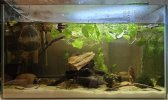
Mike, I changed 50% of water yesterday and had 34 tds and 68 conductivity just after changing. My water straight from the RO tap has tds 6, conductivity around 12. Maybe i need to perform more water changes. There is a lot of wood and leaves "rotting" inside along with a sack of peat that i change every 2 weeks, maybe that's the reason. I attached the tank photo (taken few days ago).I have another similar setup with even less water changes because there's is only one fish in there and tds/conductivity are even higher. I wanted to avoid to flush botanicals decaying products out to lower ph. Do you think the spawning fail was due to water poor quality? Woul the male spawn again with the same female provided no other female is present?
 

Attachments

  • 20251028_001836.jpg
    20251028_001836.jpg
    2.1 MB · Views: 110
Last edited:

shamedonor

Member
Messages
60
I agree. True softwater has a conductivity under 50µS/cm and no measurable GH and KH. The closest approximation to clear- and true blackwater in captivity is about 20-30µS/cm with a pH of around 5. Actual blackwater in nature is at a conductivity under 10! µS/cm with a pH below! 5.
Those were my target parameters. I thought the tank need time to rich them. But as I see now ph is not going to lower below 6.4 units. My ro water itself is 6ppm and 12mS/cm witch means something in the tank raises the parameters
 

MacZ

Well-Known Member
5 Year Member
Messages
4,323
Location
Germany
Indeed, I think the culprit is the rock weighing down the wood. Or the wand is not inert.

Keep in mind, pH measures the amount of free H+ ions. You have to add a lot to even get below a pH of 6 even with a conductivity of less than 30 microsiemens. And the further down you want the more you will have to add. Safest method is adding more and more leaf litter over time and adding the extract from alder cones and cattapa leaves after every waterchange. Takes time but as the conductivity is more important than pH it's a non-issue in my opinion. You could of course use peat, but that stuff is not sustainable and the way it is sourced is bad for the environment.
 

shamedonor

Member
Messages
60
Indeed, I think the culprit is the rock weighing down the wood. Or the wand is not inert.

Keep in mind, pH measures the amount of free H+ ions. You have to add a lot to even get below a pH of 6 even with a conductivity of less than 30 microsiemens. And the further down you want the more you will have to add. Safest method is adding more and more leaf litter over time and adding the extract from alder cones and cattapa leaves after every waterchange. Takes time but as the conductivity is more important than pH it's a non-issue in my opinion. You could of course use peat, but that stuff is not sustainable and the way it is sourced is bad for the environment.
wich wand do you mean? also might it be pool filter sand? (white one, not that glass or active stuff).
Just theoretically isn't it easier just to set up a purely RO water aquarium if the main parameter is the conductivity? Also could be nitrate the source of the high conductivity? I tested yesterday and it was just 5 but the test was expired so will re-test tonight with a good one.

Well I can remove all rocks from the tank and attach my plants to the biggest wood in the middle. Also I use oak, catappa and magnolia leaves, small oak branches and the pine and alder cones that I rinse and usually (not always though) soak in boiling water for 24 hours and then use this water and materials to add every few days into the tank.
 
Last edited:

anewbie

Well-Known Member
5 Year Member
Messages
2,702
Thanks, you're the second person mentioning this. Will stop with.

That was more for rasboras that are floating big like balloons but still no spawning. BTW how to do that temp drop correctly yo avoid the temp shock to fish?

That was rather male to lose his advantage of being introduced to the tank first. But I got it.

Mike, I changed 50% of water yesterday and had 34 tds and 68 conductivity just after changing. My water straight from the RO tap has tds 6, conductivity around 12. Maybe i need to perform more water changes. There is a lot of wood and leaves "rotting" inside along with a sack of peat that i change every 2 weeks, maybe that's the reason. I attached the tank photo (taken few days ago).I have another similar setup with even less water changes because there's is only one fish in there and tds/conductivity are even higher. I wanted to avoid to flush botanicals decaying products out to lower ph. Do you think the spawning fail was due to water poor quality? Woul the male spawn again with the same female provided no other female is present?
You can provide either ec or tds no need for both as one is 2x the other. I've not kept panduro but i do keep nijjensi and wolli. I found wc not that overly sensitive if the water is below 60 ec (the nijjensi were in my 'toy' aquarium and stil bred (and raised their youngs without input from myself). I can't say how high the ec can be for successful breeding but i know non wc pairs breed readily for people with harder water (mine are wc).

For @Mike Wise I've noticed that some of my newer aquariums can have ec as high as 100 and i did look into it when i thought the substrate might be leaching (the cup test); what i discovered was esp for newer aquarium small amount of leaf/wood decay rapidly raised the ec. Most of my aquarium settle in the 20 to 40 range with those with more plant growth going lower even if i add fertilizer (my discus tank for example maintains an ec 20 with moderate dosing). My wolli tank was one of those that spiked when i first set it up but it didn't seem to prevent breeding - it has now settle down to 30 range (though i need to locate a male somewhere one of these days).

I was a little shocked how easily the ec rose with the cup test having a small piece of leaf mixed in the water was enough to see a very large rise in ec over the week test and going to fresh substrate with nothing mixed in showed that after a month the ec remain constant at 6 - i think @MacZ speculate the bacteria itself was adding to the ec.
 

shamedonor

Member
Messages
60
You can provide either ec or tds no need for both as one is 2x the other. I've not kept panduro but i do keep nijjensi and wolli. I found wc not that overly sensitive if the water is below 60 ec (the nijjensi were in my 'toy' aquarium and stil bred (and raised their youngs without input from myself). I can't say how high the ec can be for successful breeding but i know non wc pairs breed readily for people with harder water (mine are wc).

For @Mike Wise I've noticed that some of my newer aquariums can have ec as high as 100 and i did look into it when i thought the substrate might be leaching (the cup test); what i discovered was esp for newer aquarium small amount of leaf/wood decay rapidly raised the ec. Most of my aquarium settle in the 20 to 40 range with those with more plant growth going lower even if i add fertilizer (my discus tank for example maintains an ec 20 with moderate dosing). My wolli tank was one of those that spiked when i first set it up but it didn't seem to prevent breeding - it has now settle down to 30 range (though i need to locate a male somewhere one of these days).

I was a little shocked how easily the ec rose with the cup test having a small piece of leaf mixed in the water was enough to see a very large rise in ec over the week test and going to fresh substrate with nothing mixed in showed that after a month the ec remain constant at 6 - i think @MacZ speculate the bacteria itself was adding to the ec.
might it be due to nitrate spike? New leaves = bacteria spike at no consistent plant growth in a small volume of water might be this?
 

anewbie

Well-Known Member
5 Year Member
Messages
2,702
might it be due to nitrate spike? New leaves = bacteria spike at no consistent plant growth in a small volume of water might be this?
There should be no nitrate - or no measure-able nitrate in the aquarium - at least all of my aquarium the nitrate level is well below 1. I can't explicitly answer your question because i've never tested this but i can say that in the 'old' days when i ignored nitrate levels in overly packed community tank and it was as high as 100 i never noticed a change in tds related to the high nitrate level.
 

shamedonor

Member
Messages
60
There should be no nitrate - or no measure-able nitrate in the aquarium - at least all of my aquarium the nitrate level is well below 1. I can't explicitly answer your question because i've never tested this but i can say that in the 'old' days when i ignored nitrate levels in overly packed community tank and it was as high as 100 i never noticed a change in tds related to the high nitrate level.
That's interesting as on my google search "nitrate conductivity" it says the nitrate increases conductivity.
"Since nitrate is an anion that contributes to the overall conductivity of water, a correlation often exists between EC and nitrate concentration, particularly in environments where nitrate is a dominant contaminant, such as agricultural regions with heavy fertilizer use "

I just re-tested two tanks I mentioned. Both have nitrates barely measurable (1 or 2ppm). The EC is still 70ms/cm in the tank in question and around 230ms/cm in the other one (I don't do frequent water change there as there is only one fish in there and the tank has plants). Today I will remove all rocks and perform another large 50% water change and see what happens after. And will test GH & KH.

Actually I partially used those dragon stone in my ro/tap mix water CO2 tank and I noticed that while the KH in that tank is stable as low as 5 vs 12 in the tap water, the GH in the tank was higher than expected. When I mix RO/tap the GH is around 7 in the bucket but the tank has GH at 9-10deg. I am using there the fluval stratum inert gravel substrate (basically some sort of red clay) but something is or was leaching increasing the GH value. It might be those stones and now the saturated gravels gives it back to the water as it happens with potassium that I was dosing a lot and now it is stable at 25-30pm with rare minimal dosing.
 

anewbie

Well-Known Member
5 Year Member
Messages
2,702
I would test your rocks as many will leach; you could put some in an empty aquarium (if you have a small one) with just water and wait a week test ec; wait another week test ec .... and see if they are leaching.

The reason to use an empty aquarium instead of a pail is i know most plastics will leach into ro water.
 

shamedonor

Member
Messages
60
I would test your rocks as many will leach; you could put some in an empty aquarium (if you have a small one) with just water and wait a week test ec; wait another week test ec .... and see if they are leaching.

The reason to use an empty aquarium instead of a pail is i know most plastics will leach into ro water.
thanks. what about the plexiglass aquariums? I have 3 plastic tanks that I planned to use in a similar way for other fish
 

anewbie

Well-Known Member
5 Year Member
Messages
2,702
thanks. what about the plexiglass aquariums? I have 3 plastic tanks that I planned to use in a similar way for other fish
I've not tested plexiglass but i have tested hoses (like python) and plastic pails and i know they leach. I would test the plexiglass - when i was doing some research in the topic for containers the only common plastic material i found that does not leach was polyp; though my 500 gallon container appears to not leach (it was the type label chemical resistant and certified for drinking water). I have no clue how plexi glass would respond to ro water but i know it is very corresive.
 

MacZ

Well-Known Member
5 Year Member
Messages
4,323
Location
Germany
wich wand do you mean? also might it be pool filter sand?
It was a typo. I meant the sand.

also might it be pool filter sand?
If it's pool filter sand it's not involved.

Just theoretically isn't it easier just to set up a purely RO water aquarium if the main parameter is the conductivity?
Of course. Many here do exactly that, I recommend it all the time. No mixing with tap, no adding of GH-salts. So, do I get that right, you're not using pure RO?
Also humic substances are necessary in pure RO to stabilize and to help fish with osmosregulation. These substances (colloquialliy known as tannins) do not add much conductivity either.

Also could be nitrate the source of the high conductivity? I tested yesterday and it was just 5 but the test was expired so will re-test tonight with a good one.
No, not to at all. That would add maybe 5-10 µS.

Also I use oak, catappa and magnolia leaves, small oak branches and the pine and alder cones that I rinse and usually (not always though) soak in boiling water for 24 hours and then use this water and materials to add every few days into the tank.
Good practice.

I'm in a bit of a rush right now, will say something more detailied tonight.
 

shamedonor

Member
Messages
60
I've not tested plexiglass but i have tested hoses (like python) and plastic pails and i know they leach. I would test the plexiglass - when i was doing some research in the topic for containers the only common plastic material i found that does not leach was polyp; though my 500 gallon container appears to not leach (it was the type label chemical resistant and certified for drinking water). I have no clue how plexi glass would respond to ro water but i know it is very corresive.
I will try RO water with an empty plexi glass tank. Though the one in question is a regular glass. I rebuilt it personally with the SCS1200 silicone that i was recomended to use by few aquarists and tank builders
 

shamedonor

Member
Messages
60
It was a typo. I meant the sand.


If it's pool filter sand it's not involved.
Yes, that was really a white fin pool sand like this one https://www.boldtpools.ca/store/residential-filter-sand/
Of course. Many here do exactly that, I recommend it all the time. No mixing with tap, no adding of GH-salts. So, do I get that right, you're not using pure RO?
Also humic substances are necessary in pure RO to stabilize and to help fish with osmosregulation. These substances (colloquialliy known as tannins) do not add much conductivity either.
Yes, I do use the a pure RO water. It has tds 6-7ppm for now. NO salts, no buffers etc.
I take that RO water in a bucket, and if I have I add some water where I soaked some oak, magnolia leaves and pines. If I don't, it goes in the tank as is. Then, once every few days, I drop a couple of new leaves into the tank. The indicator here is the color of the old water. If the old water is not that brown it is time to add some botanicals.

No, not to at all. That would add maybe 5-10 µS.


Good practice.

I'm in a bit of a rush right now, will say something more detailied tonight.
No problem.
 

Members online

Forum statistics

Threads
18,703
Messages
124,172
Members
13,590
Latest member
jukaklimatyzacje

Latest profile posts

Platforma SaldeoSMART automatyzuje obieg dokumentów i odczyt faktur (OCR) w firmach oraz biurach rachunkowych. System jest gotowy na zmiany prawne, a integracja z ksef pozwala na bezpieczne wysyłanie i odbieranie e-faktur ustrukturyzowanych.
dimandobson wrote on Ben Bergman's profile.
Hi Bergman. I have a pair of breeding dwarf cichlid for sale. if you are still looking, drop me your whatsapp number and i will send some videos to your whatsapp
Good-backlink.com - Professional website promotion, get more traffic to your website and improve ranking by using high PR link building service.
martin_c wrote on illumnae's profile.
Hi,

just in case you happen to live in Germany (or Netherlands): I have a wildcaught female A. psammophila, you could have it for free. I have no use for it anymore.

BR
Martin
Top