• Hello guest! Are you an Apistogramma enthusiast? If so we invite you to join our community and see what it has to offer. Our site is specifically designed for you and it's a great place for Apisto enthusiasts to meet online. Once you join you'll be able to post messages, upload pictures of your fish and tanks and have a great time with other Apisto enthusiasts. Sign up today!

Apistogramma agassizii biotope

Joni_99

New Member
Messages
12
Location
Germany
Hello,
I want to know how a Apistogramma agassizii looks like. Can my fish for a biotope aquarium stay in the aquarium. My fishs are:
  • 1/1 Apistogramma agassizii
  • 1/0 Ancistrus spec.
  • 2/8 Poecilia
  • 5 Caridinia japonica
It is a 112l/ca.30 gallon tank.

So it looks. But now without Trigostonima heteromorpha.
6,8 pH
10 GH
4 KH
0 Nitrat + Nitrit
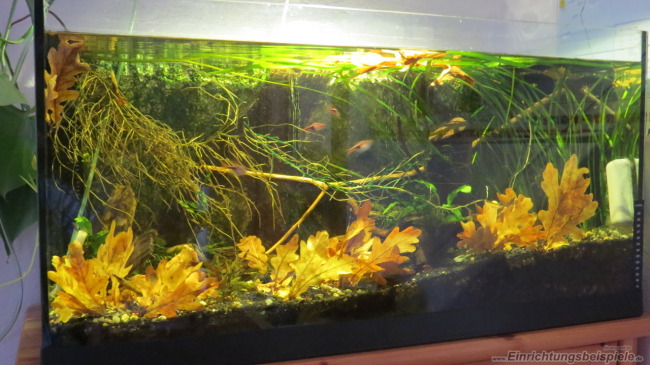
20-10-14__5c0665516f70db47e524a7d0e0a3e873.jpg
 

dw1305

Well-Known Member
5 Year Member
Messages
2,980
Location
Wiltshire UK
Hi all,
Shrimp like caridine?
I'd be worried about the Amano shrimps when they molted. I think the adults would be large enough to be avoided otherwise, and shrimplets aren't an issue with Amano shrimps.

My experience with A. cacatuoides was that they were really keen on Red Cherry Shrimps, and even sub-adults could manage to eat them.

I think the shrimps will eat any Apistogramma fry, and also that the Ancistrus is likely to eat any Apistogramma eggs/wrigglers at night, unless it is a very secure cave.

cheers Darrel
 

Joni_99

New Member
Messages
12
Location
Germany
Hello,
Here are some photos of the fish. I want to know from where and what a type of agassiii they are? How looks the biotope. Have somebodys pichtures or video?
 

Attachments

  • IMG_6182.JPG
    IMG_6182.JPG
    3.2 MB · Views: 1,250
  • IMG_6179.JPG
    IMG_6179.JPG
    2.8 MB · Views: 1,511

Tom C

Well-Known Member
5 Year Member
Messages
606
Location
Norway
..... How looks the biotope.
Apistogramma belong to the tribe Geophagini, which means that they "eat earth". This is a very frequent and natural behavior, they will normally sift the substrate almost all day long.

I strongly believe that most Apistogramma species won't thrive in the long term without fine sand on the bottom.

Frank Schäfer (Aquarium Glaser, Germany), wrote not long ago:
"Especially the sand is important and the meaning of it often underestimated.
In fact the sand is more important than the water chemistry (hardness, pH).
In the wild, these fish feed mainly on particles they find in the sand.
To find them the fish takes a mouth full of sand, chews the sand and releases the sand through the gill openings.
Food particles attach on special anatomical structures on the gill arches and can be swallowed subsequently.
In case an Apistogramma can find no sand it comes in a situation comparably to humans that get no opportunity to clean their teeth.
This may work for a while, but in most cases sooner or later one becomes sick of it.
"

This is one of the habitats where I have collected Apistogramma:

resizeimage.aspx


Sand almost as fine as flour, and leaf litter.

And this is how Apistos look like most of the time, when they have the right substrate, when they let the fine sand out again:

resizeimage.aspx
 

Rico Suave

Member
Messages
34
Apistogramma belong to the tribe Geophagini, which means that they "eat earth". This is a very frequent and natural behavior, they will normally sift the substrate almost all day long.

I strongly believe that most Apistogramma species won't thrive in the long term without fine sand on the bottom.

Frank Schäfer (Aquarium Glaser, Germany), wrote not long ago:
"Especially the sand is important and the meaning of it often underestimated.
In fact the sand is more important than the water chemistry (hardness, pH).
In the wild, these fish feed mainly on particles they find in the sand.
To find them the fish takes a mouth full of sand, chews the sand and releases the sand through the gill openings.
Food particles attach on special anatomical structures on the gill arches and can be swallowed subsequently.
In case an Apistogramma can find no sand it comes in a situation comparably to humans that get no opportunity to clean their teeth.
This may work for a while, but in most cases sooner or later one becomes sick of it.
"

This is one of the habitats where I have collected Apistogramma:

resizeimage.aspx


Sand almost as fine as flour, and leaf litter.

And this is how Apistos look like most of the time, when they have the right substrate, when they let the fine sand out again:


wowwww this really makes me want to re do some tanks now...is the stuff u find at the petland and petsmart fine enough or do i need to look online for something that fine? will this concept work with other dwarf cichlids ?
 

Tom C

Well-Known Member
5 Year Member
Messages
606
Location
Norway
I live in Norway and unfortunately I know nothing about the sand sold in US!

It's important that the sand is fine, rounded (not sharp/crushed), and that it does not affect water parameters negatively.

And yes, this fits all South American dwarf cichlids.
 

dw1305

Well-Known Member
5 Year Member
Messages
2,980
Location
Wiltshire UK
Hi all,
In European commerce are there an commercial sand that like natural sand of south American river?
You can use "silica swimming pool sand". I like the finer grades 0.5 - 1mm, and you need "natural rounded silica" as some of it is re-cycled glass now.

cheers Darrel
 

dw1305

Well-Known Member
5 Year Member
Messages
2,980
Location
Wiltshire UK
Hi all,
I saw it, but I don't like because it is too white..
You may be able to get a much more "sandy" coloured sand. I was put off initially, but once you add some dead leaves etc. you don't have an expanse of white sand.

This tank has white silica sand, but it has never bothered the fish.

dicrossus_clup1_resize.jpg


cheers Darrel
 

Tom C

Well-Known Member
5 Year Member
Messages
606
Location
Norway
Above the surface the sand looks quite white, when dry:

Rio Itaya:
resizeimage.aspx


Rio Nanay:
resizeimage.aspx


But beneath the surface it looks different:

Rio Tahuayo:
resizeimage.aspx


Rio Tapiche:
resizeimage.aspx
 

Mike Wise

Moderator
Staff member
5 Year Member
Messages
11,871
Location
Denver, Colorado, U.S.A.
Another question is? Are Paracheirodon Axelrodi from the same biotope as Apistogramma agassizii and what do you say to this?

Yes and no. The natural range of P. axelrodi is the upper Rio Negro to the upper Río Orinoco. A. agassizii is found naturally in the lower Rio Negro, below the Rio Branco to its mouth at Manaus. Due to the way fish are kept prior to export in Manaus, in net traps in small streams, P. axelrodi is now found in the neighborhood of Manaus.
 

Members online

Forum statistics

Threads
18,707
Messages
124,195
Members
13,591
Latest member
flanormimar

Latest profile posts

Platforma SaldeoSMART automatyzuje obieg dokumentów i odczyt faktur (OCR) w firmach oraz biurach rachunkowych. System jest gotowy na zmiany prawne, a integracja z ksef pozwala na bezpieczne wysyłanie i odbieranie e-faktur ustrukturyzowanych.
dimandobson wrote on Ben Bergman's profile.
Hi Bergman. I have a pair of breeding dwarf cichlid for sale. if you are still looking, drop me your whatsapp number and i will send some videos to your whatsapp
Good-backlink.com - Professional website promotion, get more traffic to your website and improve ranking by using high PR link building service.
martin_c wrote on illumnae's profile.
Hi,

just in case you happen to live in Germany (or Netherlands): I have a wildcaught female A. psammophila, you could have it for free. I have no use for it anymore.

BR
Martin
Top