• Hello guest! Are you an Apistogramma enthusiast? If so we invite you to join our community and see what it has to offer. Our site is specifically designed for you and it's a great place for Apisto enthusiasts to meet online. Once you join you'll be able to post messages, upload pictures of your fish and tanks and have a great time with other Apisto enthusiasts. Sign up today!

Mislabeled as Laetacara curviceps?

AlexBL

New Member
Messages
2
Hello everyone,

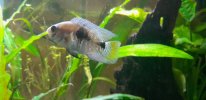
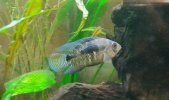
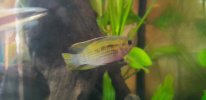
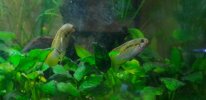
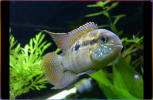
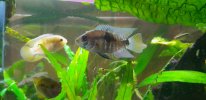
kindly asking for help with correct identification of the fish pictured below. I bought it a month ago in a LFS as a male Laetacara curviceps to cheer up my recently widowed female L curviceps. The fish appeared to be the alpha male in a tank full of clear Laetacara curviceps.

When I came home and released the fish into a quarantine, I immediately realized that most likely this was not Laetacara curviceps. While the coloration was similar, the differences in body shape and behavior were clear. Due to logistics issues, I could not return the fish to the LFS right away so I decided to keep it nevertheless. Few weeks later, I released it into a 300L aquarium with 4 Laetacara dorsigera, the (widowed) female L curviceps and some Apistogramma macmasteri.

So far it's working without any issues, but it's clear that this is no Laetacara. It's extremely active and voracious eater. It measures roughly 7centimeters (including fins) and has a large black spot on a side. Any ideas what the fish could be? So far, after investigating a bit myself online, my best guess would be Cichlasoma pusillum, but the evidence is inconclusive. Hence, it would be great if anybody could either confirm that this is C pusillum or perhaps identify it as something else. It would be great to know what exact fish this is so that I know how big it can get.

Any help would be appreciated. Thanks!
 

Attachments

  • 1000050243.jpg
    1000050243.jpg
    3.5 MB · Views: 17
  • 1000050246.jpg
    1000050246.jpg
    3.7 MB · Views: 18
  • 1000050265.jpg
    1000050265.jpg
    1.1 MB · Views: 16

KenL

Active Member
5 Year Member
Messages
350
It is a lovely fish. It looks like a Laetacara to me, the tail markings especially.
Thayeri perhaps?
 

anewbie

Well-Known Member
5 Year Member
Messages
2,896
It is a lovely fish. It looks like a Laetacara to me, the tail markings especially.
Thayeri perhaps?
Definitely not Thayeri which i've had. It is either l. dors or l. curv - i believe they are dors but i'll let the expert chime in even if i'm pretty sure they are dors ;)
 

AlexBL

New Member
Messages
2
Thanks for a response! It absolutely is a lovely fish, that's why I'm in no rush to return it to LFS - unless I find out that its tank requirements exceed my capacities.

Nevertheless, I'm really sceptical about this particular fish being a Laetacara. As I said, I currently have 2 pairs of L. dorsigera and have had multiple pairs of L. curviceps in the past. All these Laetacaras have always been relatively subdued and timid. On the other hand, the fish in question was eating out of my hands on the second day. Its body shape is also a bit different and visibly bulkier. It easily eats as much food as all the 4 L dorsigera combined. It also does not seem to exhibit any sort of agression towards them. (Which was not entirely the case when I was trying to keep 4 dorsigera with 2 curviceps in the same tank.)
 

anewbie

Well-Known Member
5 Year Member
Messages
2,896
Thanks for a response! It absolutely is a lovely fish, that's why I'm in no rush to return it to LFS - unless I find out that its tank requirements exceed my capacities.

Nevertheless, I'm really sceptical about this particular fish being a Laetacara. As I said, I currently have 2 pairs of L. dorsigera and have had multiple pairs of L. curviceps in the past. All these Laetacaras have always been relatively subdued and timid. On the other hand, the fish in question was eating out of my hands on the second day. Its body shape is also a bit different and visibly bulkier. It easily eats as much food as all the 4 L dorsigera combined. It also does not seem to exhibit any sort of agression towards them. (Which was not entirely the case when I was trying to keep 4 dorsigera with 2 curviceps in the same tank.)

The only problem with keeping dors with curv is they can technically cross breed. It is common for the domestic blue form of dors to be sold as curv in the usa - the curvs tend to be slimmer and body pattern different - seen pictures but of course some pictures are mislabelled ;) I have wc red form dors now and they are a lot smaller then the domestics. Maybe 1/2 the size.

The thing that is confusing me is the tail spot. Mrs. google sez the species with a tail spot are araguaiae but the ones i've had have been a bit more colourful.

Anyway araguaiae are compatible with the other two species in terms of behavior et all but again technically they can cross breed. My last group aged out but they are easy to breed just soft water (120tds is fine) and don't have the temp too high.
 
Last edited:

MacZ

Well-Known Member
5 Year Member
Messages
4,419
Location
Germany
I'm leaning towards a young Andinoacara. But don't pin me on saying which species. The snout shape and the eye-size to body ratio point me that way.
 

anewbie

Well-Known Member
5 Year Member
Messages
2,896
I'm leaning towards a young Andinoacara. But don't pin me on saying which species. The snout shape and the eye-size to body ratio point me that way.
You mean it is going to be a green terror and destroy everything ?
 

anewbie

Well-Known Member
5 Year Member
Messages
2,896
There is an Andinoacara sp. “Orinoco” that is really spectacular looking and just maybe it won't terrorize the neighborhood :)
 

MacZ

Well-Known Member
5 Year Member
Messages
4,419
Location
Germany
You mean it is going to be a green terror and destroy everything ?
There are more species of Andinoacara. It could be a hybrid or a young A. pulcher. But not A. rivulatus, no worries. As I haven't kept them I can only guess.
 

LBT

Member
Messages
50
Possible identification: Andinoacara cf. pulcher


It was sold as Laetacara curviceps, but I am quite certain that identification is incorrect.


Judging from its body shape, head profile, the prominent dark lateral spot, the separate spot on the caudal peduncle, and the blue-green iridescent markings on the head and fins, I believe it is an Andinoacara, most likely belonging to the pulcher/coeruleopunctatus group.


Andinoacara coeruleopunctatus initially seemed like a good possibility, as the colour pattern is quite similar to some specimens from Panama. However, A. coeruleopunctatus appears to be relatively uncommon in the aquarium trade, whereas A. pulcher and commercially bred Andinoacara are much more widely available.


This makes me wonder whether it might simply be a normally coloured, commercially bred A. pulcher or a pulcher-type fish originating from breeding stock associated with Electric Blue Acara. A sorting or labelling error somewhere in the supply chain could then explain how it ended up being sold as Laetacara curviceps.


Unfortunately, there is no information about its geographical origin or breeding line, so I don’t think a definite species identification is justified from appearance alone. For the moment, I would therefore label it:


Andinoacara cf. pulcher — commercial aquarium stock, exact origin unknown.

Size and behaviour

If this is indeed an Andinoacara of the pulcher/coeruleopunctatus group, I would expect an adult size of roughly 12–15 cm, with some specimens potentially growing larger. This is considerably larger and more robust than Laetacara curviceps.

This particular fish is kept as a single specimen, so breeding-related aggression is not an issue. A single Andinoacara is generally a fairly manageable cichlid, but it can still be territorial and assertive towards other fish, especially other cichlids or bottom-dwelling species. With sufficient aquarium space, visual barriers and suitably sized tankmates, it is usually quite suitable for a community of medium-sized fish.

I would therefore treat it as a medium-sized, moderately territorial cichlid rather than a dwarf cichlid. If a mate were ever added and a pair formed, territorial behaviour could increase considerably during spawning and brood care.

I would be very interested to hear opinions from people familiar with wild-type A. pulcher, A. coeruleopunctatus, or the various Andinoacara forms found in the aquarium trade.
 

Members online

Latest posts

Forum statistics

Threads
18,780
Messages
125,070
Members
13,670
Latest member
ApistoNut

Latest profile posts

Re-designing and starting a new fish room all over again. This time we'll have many more Apistsogramma species. We are expanding.
dimandobson wrote on Arnold's profile.
hi
dimandobson wrote on Ben Bergman's profile.
Hi Bergman. I have a pair of breeding dwarf cichlid for sale. if you are still looking, drop me your whatsapp number and i will send some videos to your whatsapp
martin_c wrote on illumnae's profile.
Hi,

just in case you happen to live in Germany (or Netherlands): I have a wildcaught female A. psammophila, you could have it for free. I have no use for it anymore.

BR
Martin
Top