- Messages
- 21
Not a thread specifically seeking advice (for a change) but rather a post about my personal experiences and observations I've recently had with hole in the head and ripped fins affecting my female and male Macmasteri, respectively.
I thought it might be worth sharing to help others prevent the onset of these issues, and help with potential trouble shooting if encountered.
HITH
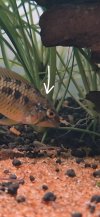
My female had a very small and barely noticeable open wound on the back of her head so I didn't even notice it (first pic) to begin with. It slowly got bigger over time and it became more noticeable. I then paid more attention to it kept an eye on it to see to see if it would get any bigger and to watch out for any secondary infections. It was in fact getting bigger and got to 3-4mm and would have kept getting worse without intervention. I don't have a photo of when it was at its worse, but it was approximately 4mm x 3mm. I then decided to make some changes.
Having read some threads online, I decided to take the least aggressive option to start with, and went with a non medicated route.
1. Water changes - 30%, 2-3 times per week
2. Catappa leaves - approximately 1 for every 5 gallons.
3. Removed activated carbon from the filter
4. Increase in temperature by 1 degree (26 degrees celsius)
5. Diet of mainly black worms, with some days of Fluval bug bites.
Over about 3-4 days, she started recovering.
Torn Fins
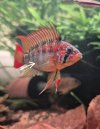
My male, when I received him, had a small tear through the fin close to the base. A day or two later, he managed to tear it completely wide open. Shown in the second photo.
I didn't do anything differently except up the water changes to twice per week at 30%. All other parameters were the same to when I was treating the female for HITH.
I believe the key takeaway was that consistent, high-quality water and diet played a critical role in their recovery, as well as early detection. The initial trigger for the female's HITH isn't definite, but it was likely environmental stress. Specifically, increased human presence, i.e. late-night activity and lights being turned on/off in the evenings when we had guests, combined with possible feeding/water quality issues while I was away, which I suspect played a major part in their health.
I thought it might be worth sharing to help others prevent the onset of these issues, and help with potential trouble shooting if encountered.
HITH
My female had a very small and barely noticeable open wound on the back of her head so I didn't even notice it (first pic) to begin with. It slowly got bigger over time and it became more noticeable. I then paid more attention to it kept an eye on it to see to see if it would get any bigger and to watch out for any secondary infections. It was in fact getting bigger and got to 3-4mm and would have kept getting worse without intervention. I don't have a photo of when it was at its worse, but it was approximately 4mm x 3mm. I then decided to make some changes.
Having read some threads online, I decided to take the least aggressive option to start with, and went with a non medicated route.
1. Water changes - 30%, 2-3 times per week
2. Catappa leaves - approximately 1 for every 5 gallons.
3. Removed activated carbon from the filter
4. Increase in temperature by 1 degree (26 degrees celsius)
5. Diet of mainly black worms, with some days of Fluval bug bites.
Over about 3-4 days, she started recovering.
Torn Fins
My male, when I received him, had a small tear through the fin close to the base. A day or two later, he managed to tear it completely wide open. Shown in the second photo.
I didn't do anything differently except up the water changes to twice per week at 30%. All other parameters were the same to when I was treating the female for HITH.
I believe the key takeaway was that consistent, high-quality water and diet played a critical role in their recovery, as well as early detection. The initial trigger for the female's HITH isn't definite, but it was likely environmental stress. Specifically, increased human presence, i.e. late-night activity and lights being turned on/off in the evenings when we had guests, combined with possible feeding/water quality issues while I was away, which I suspect played a major part in their health.