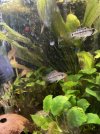
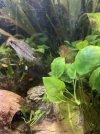
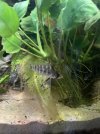
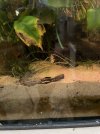
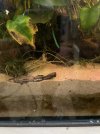
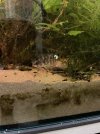
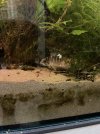
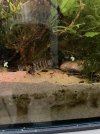
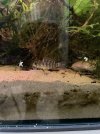
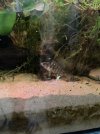
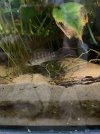
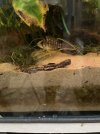
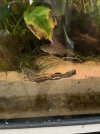
Thank you for your reply. These fish came from Peru. Unfortunately I don't have more information. After a few more days of settling in, both start to show orange in the tail. The one which I am pretty sure is a male, also has steelblue on the gill, red and blue stripes and spots on the gill and a redish hue around the pectoral fins.One of your fish shows very distinct split vertical bars, something I have never seen on any A. moae. On all the pictures of the latter I know, merely in one picture I can see a very faint split bar. Therefore, unlike A. moae, your fish are for sure an eunotus-subcomplex species and if this is the case, it doesn't makes much sense to call them A. cf. moae in the first place. Anyway, do you have any information on the catch location? Are they even from Brazil?
Thank you for your reply. I understand that the eunotus complex is a rather diverse group with many variations and transition forms. Any idea why these fish were sold as cf. moae instead of cf. eunotus? It would certainly be safer, since both species aren't particulary sought after.It seems, from your description of their color, that the could be A. cf. eunotus (Orangeschwanz). This species is found around Iquitos, Peru and matches what you have described.
Knowing that your fish are from Peru and show distinct split bars, it in fact doesn't makes any sense at all to call them A. cf. moae instead of A. cf. eunotus.Any idea why these fish were sold as cf. moae instead of cf. eunotus? It would certainly be safer, since both species aren't particulary sought after.
New and/or rare always brings in more interest - and money.Any idea why these fish were sold as cf. moae instead of cf. eunotus? It would certainly be safer, since both species aren't particulary sought after.
That's just 30 km (18 miles) from Rio Moa in Brazil.I think i have seen the same stocklist as LBT. The describtion says: RÍO YURÚA, PERU.
-if that is any help.
-r
Thank you for your reply. To me it just proves that they are very interesting. Either way they are fish that tell a story. The nadelstreif (needlestripe) is one I never heard of before. Since we have no way of knowing if it's the real collection site, I will for the time being refer to them as A. cf. moae. I will keep foto updates as they grow and hopefully spawn.First, Cruzeiro do Sul is located on the upper Rio Jurua. The Rio Moa, a tributary of the Jurua, is the type locality for A. moae. So that part seems ok. However all 'typical' eunotus-subcomplex species (= noticable split vertical bar(s) on caudal peduncle) are found in tributaries of the Rio Ucayali or close to the main channel of the Amazon in Peru, Colombia, and Brazil. There are species that can be questionably assigned to the subcomplex - like A. moae and A. sp. Nadelsteifen. Based on your latest photos, your fish fish appear to be in the moae/Nadelstreifen part. This is a problem that often occurs with not seeing the actual fish or with a limited number of photos that do not show the fish in different behaviors. Personally, based on the photos shown here, I see no problem labeling them as either A. cf. moae or A. cf. eunotus. If the collection site that was given is accurate, then A. cf. moae would be the better choice. That being said, commercial collectors often give inacurate collecting data to hide their true collecting sites from other commercial collectors.