• Hello guest! Are you an Apistogramma enthusiast? If so we invite you to join our community and see what it has to offer. Our site is specifically designed for you and it's a great place for Apisto enthusiasts to meet online. Once you join you'll be able to post messages, upload pictures of your fish and tanks and have a great time with other Apisto enthusiasts. Sign up today!

Aggression Female

bettaman

New Member
Messages
2
Hi I'm new to apistogramma. I bought my first pair recently (they were sold as a pair). They're now in a 75g peaceful community setup. Initially the male was dominant. However, the female has now made her territory right in the center of the tank. She would chase any fish that approaches near her rocks. I notice that the male also avoids her territory. He doesn't have a territory and is a roamer. My questions are
1. It's my male a goner? I used to keep betta and I know that dominant females would kill off a weaker male.
2. How aggressive are apistogramma? My male gets along well with the clown loaches and hoplo in the tank. I'm worried that the female is going to become a nuisance.
Here are the tank mates
1. A pair of golden panchax
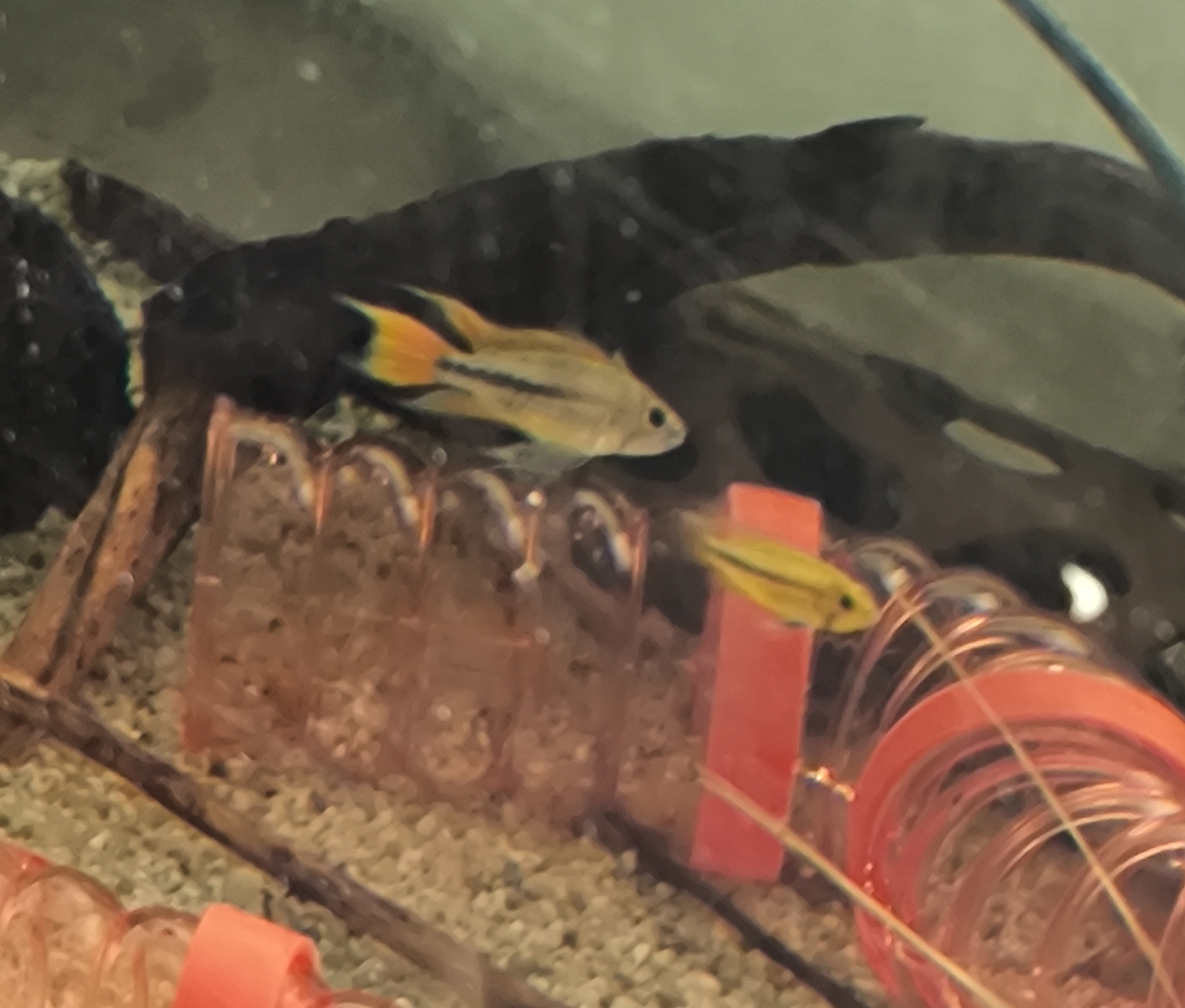
1000038187.jpg

2. A pair of Raphael catfishes
3. A pair of spotted Hoplos
4. A pair of clown loaches
Thanks for the advice
 

MacZ

Well-Known Member
5 Year Member
Messages
4,323
Location
Germany
Apistogrammaof the polygamous kind (basically all besides the A. nijsseni-species group), have a kind of cycle.

Usually a male doesn't tolerate non-receptive females in his territory. So a female that is not ready to breed is going to be chased and harassed, often with fatal result unless the tank is big enough and well structured so the female can evade his approaches and get ready for the receptive state, which I call "wasp mode" as they usually become yellow with dark black markings, like a wasp.

Then tables turn as soon as they have spawned. A brooding female is a menace to every fish in the tank. I have seen a female A. macmasteri and a female A. hongsloi each pushing the whole stock of a 120cm tank into one corner and wouldn't let anybody leave that area without showing some kind of aggression from showing aggressive display to outright attacking and killing other fish. This included Otocinclus, Tetras of different sorts and kuhli loaches. Even Angelfish and bigger cichlids were attacked, but were not killed. This is the only kind of aggression you will see from Apistogramma towards other species. Only when brooding.

Downside: If you have other bottomdwellers like Corydoraoid catfish those do not understand the threat display and ignore it. While these catfish are heavily armored and thus can't be killed, they may loose an eye and the female Apisto may burn out in such an environment, as she will be on edge permanently. About 5 broods may be her undoing.

Hence it is always a good advice to have a second tank ready and running to separate these fish at any given time. Otherwise losses are likely.

This is one of the main reasons experienced people like Mike Wise have the mantra "A community tank is not a breeding tank".

In a community tank I would usually only keep a single male or, if the tank is big enough a bachelor group (odd numbers!) without any females.

So in your case: Separate them permanently.

Here are the tank mates
1. A pair of golden panchax
2. A pair of Raphael catfishes
3. A pair of spotted Hoplos
4. A pair of clown loaches
Thanks for the advice
This is also not a good combination anyway. Apistogramma are strictly diurnal, several species you have are nocturnal and grow to multiple the size and mass of Apistogramma. If they roam at night it is like a Bus drives through your bedroom, this will stress the Apistos long term and stress is the number one killer for dwarf cichlids in captivity.

You are also aware of the fact that the loaches and catfish require bigger numbers? And that the loaches will reach 30cm length, requiring at least a 2 meter tank as soon as they reach the 20cm mark?

So in your case: Separate them permanently.
And to add on my own advice: Remove the Apistos from that tank. Big, nocturnal fish are not appropriate tankmates for dwarf cichlids.
 

MacZ

Well-Known Member
5 Year Member
Messages
4,323
Location
Germany
Gosh. I wish I knew that before I purchased the pair. Thanks for the insights.
Don't punish yourself for it. Let the most important takeaway from this be: First research what you want to keep, then buy or don't. And the golden rule: Tailoring a fishtank to the future inhabitants' needs prevents most unnessecary deaths.
 

Members online

No members online now.

Forum statistics

Threads
18,703
Messages
124,172
Members
13,589
Latest member
rozyjuise

Latest profile posts

Platforma SaldeoSMART automatyzuje obieg dokumentów i odczyt faktur (OCR) w firmach oraz biurach rachunkowych. System jest gotowy na zmiany prawne, a integracja z ksef pozwala na bezpieczne wysyłanie i odbieranie e-faktur ustrukturyzowanych.
dimandobson wrote on Ben Bergman's profile.
Hi Bergman. I have a pair of breeding dwarf cichlid for sale. if you are still looking, drop me your whatsapp number and i will send some videos to your whatsapp
Good-backlink.com - Professional website promotion, get more traffic to your website and improve ranking by using high PR link building service.
martin_c wrote on illumnae's profile.
Hi,

just in case you happen to live in Germany (or Netherlands): I have a wildcaught female A. psammophila, you could have it for free. I have no use for it anymore.

BR
Martin
Top