• Hello guest! Are you an Apistogramma enthusiast? If so we invite you to join our community and see what it has to offer. Our site is specifically designed for you and it's a great place for Apisto enthusiasts to meet online. Once you join you'll be able to post messages, upload pictures of your fish and tanks and have a great time with other Apisto enthusiasts. Sign up today!

Hello, nice to be here!

mfsb888

New Member
Messages
12
Hello all,

Glad to have found this place, recommended to me by a fellow hobbyist.

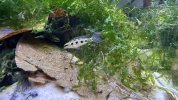
I've recently been fortunate enough to get some wild-caught Dicrossus filamentosus, a fish that has been on my bucket list for a few years now. I'm a fairly experienced hobbyist but this is my first serious dive into soft water species.

Here's a clip of the trio in one of my tanks from earlier today:


And here's a clip of a pair I have in another tank:


Discovered eggs last night in the tank which houses the trio, but the female who laid them never showed the deep orange (or any) color on her ventrals before or after. The nest is way in the back, so I wasn't able to observe "during". Is this common, and if so what does it signify?

Looking forward to meeting and communicating with all, but specifically those who have worked or are working with Dicrossus - and yes, Apistogramma are absolutely on my radar as a future project.

Thanks, and cheers!
 

Attachments

  • IMG_1832.jpeg
    IMG_1832.jpeg
    2.7 MB · Views: 111

MacZ

Well-Known Member
5 Year Member
Messages
4,323
Location
Germany
Welcome!
I would separate the trio to be honest and then look into options. Because if the aggression level seen in the video stays like this you have 2 weeks until you risk losing fish.
 

Mike Wise

Moderator
Staff member
5 Year Member
Messages
11,869
Location
Denver, Colorado, U.S.A.
Without knowing the size of the tank I cannot say anything about future aggression level.

I haven't kept D. filamentosa for several decades now, but my females generally developed red ventral fin once fry became freeswimming.
 

mfsb888

New Member
Messages
12
Welcome!
I would separate the trio to be honest and then look into options. Because if the aggression level seen in the video stays like this you have 2 weeks until you risk losing fish.

Thank you for your reply. Fortunately I'm WFH for the rest of the week so will be able to keep a close eye on things. I do have somewhere to move her to if things get nasty. Their tank was scaped with 5 different zones, 2 completely hidden from even my view and plenty of broken sightlines.

Once again, have never worked with them before and am hoping for some clarification so that I can choose the best path forward. Do they actually form pair bonds and if so is it only during/shortly after spawning, or are they harem spawners?
 

mfsb888

New Member
Messages
12
Without knowing the size of the tank I cannot say anything about future aggression level.

I haven't kept D. filamentosa for several decades now, but my females generally developed red ventral fin once fry became freeswimming.
Thanks for this info, Mike! My online research did not detail that this doesn't occur until the fry are free swimming. The female in the tank with a pair came in with the distinct orange ventrals, which is how I was easily able to pick her out of a tank at my LFS.

The tank the trio is in is a 12g long (the other pair is in a 10g). Here's a clip:


Scape was conceptualized with 5 distinct zones and I'm aware it's on the small size. Defintely appreciate any further feedback and input.
 

MacZ

Well-Known Member
5 Year Member
Messages
4,323
Location
Germany
Do they actually form pair bonds and if so is it only during/shortly after spawning, or are they harem spawners?
Males are usually not invested in brooding. They are also much more aggressive towards non-receptive females than many Apistogramma if they are aggressive. I have only seen all or nothing type of behaviour. That's why I recommended separating them.
 

mfsb888

New Member
Messages
12
Males are usually not invested in brooding. They are also much more aggressive towards non-receptive females than many Apistogramma if they are aggressive. I have only seen all or nothing type of behaviour. That's why I recommended separating them.

Totally understand and appreciate the suggestion, and have been monitoring rather vigilantly since the initial aggression pictured in the clip.

The social interaction between the trio is quite interesting. Yesterday I checked the hidden nest in the back (via cell phone camera, the way I discovered them) and they were all gone. This morning he seems to have had a change of heart towards female B (the one he did not spawn with). He's always preferred female A but nature in a 12g glass box seems to be a strong motivator. Prior to today he would always run her off. Clip shot an hour ago with female B.


I've set up a 5g with same water parameters in case she needs to be separated. Being that this is a total learning experience for me, I'm hoping to see how this pans out. I posted a clip of the tank, and feel that she has enough moxy to escape to one of the other open zones in the scape and once again will be monitoring closely.
 

Mike Wise

Moderator
Staff member
5 Year Member
Messages
11,869
Location
Denver, Colorado, U.S.A.
The orange pectorals that your female showed indicates that she had previously spawned, probably before capture. As for the tanks, I personally would not keep a trio of them in such small tanks. I also found D. filamentosus females to be rather "casual" in their brood behavior. I once saw a female happily fanning her eggs while another female was eating them!
 

mfsb888

New Member
Messages
12
The orange pectorals that your female showed indicates that she had previously spawned, probably before capture. As for the tanks, I personally would not keep a trio of them in such small tanks. I also found D. filamentosus females to be rather "casual" in their brood behavior. I once saw a female happily fanning her eggs while another female was eating them!

A well-fed female is a happy one?

Do people generally pull the male after eggs hatch?

When you were working with these, did you keep them in pairs or a harem? Part of me wants to have a pair/harem (A/B) point of comparison to observe and learn more about these fish. Assuming the tank would be as heavily scaped as my 12g, what is the minimal size tank you would attempt to keep a trio in?

Input and feedback from the hive gladly welcomed as well as appreciated here - thanks and have a great weekend.
 

MacZ

Well-Known Member
5 Year Member
Messages
4,323
Location
Germany
Do people generally pull the male after eggs hatch?
If you are aiming to breed for profit and have a whole array of small tanks, yes. In a sufficiently big tank no, but then breeding isn't the goal either.

Minimum size for a trio in my opinion: 120x50x50cm.
Minimum size for breeding: 60x40x30 and remove the male after spawning and pull the fry once the mother stops caring.
 

mfsb888

New Member
Messages
12
If you are aiming to breed for profit and have a whole array of small tanks, yes. In a sufficiently big tank no, but then breeding isn't the goal either.

Minimum size for a trio in my opinion: 120x50x50cm.
Minimum size for breeding: 60x40x30 and remove the male after spawning and pull the fry once the mother stops caring.

Sure, would eventually like to sell the offspring should I have any success with them but ultimately am content to observe the process, especially this first time around, to learn and grow from it - then perhaps a more focused effort on actual production. Have only had the initial pair for less than a month and the trio for less than two weeks, but so far have been enjoying the ride!

Right now for me it's the journey, not the destination.
 

Mike Wise

Moderator
Staff member
5 Year Member
Messages
11,869
Location
Denver, Colorado, U.S.A.
My trio was in a 20 long (30x12x12"/75x30x30cm) and they produced fry. This is what I consider a minimum size IF properly decorated (do a search here for proper decor). Also if you plan to breed them for numbers I suggest having at least 3 tanks.
 

mfsb888

New Member
Messages
12
My trio was in a 20 long (30x12x12"/75x30x30cm) and they produced fry. This is what I consider a minimum size IF properly decorated (do a search here for proper decor). Also if you plan to breed them for numbers I suggest having at least 3 tanks.

The trio is still under close observation. I do have a 20 long that is currently occupied by a group of wild Corydoras, (as well as some livebearers I'm in the process of re-homing) so I do have concepts of a backup plan.

When you had your trio, did the male ever experience preference for one of the females? The male in my trio is right back with female A whose clutch disappeared despite the fact that female B appears rotund and ready to go. He's totally tolerant of female A wherever she is, and even courted/led her back into her nest where eggs were laid earlier this week, and she willingly followed. I was under the impression that females usually initiate the spawning.

A bird in hand is worth two in the bush?


Members online

Forum statistics

Threads
18,703
Messages
124,172
Members
13,589
Latest member
rozyjuise

Latest profile posts

Platforma SaldeoSMART automatyzuje obieg dokumentów i odczyt faktur (OCR) w firmach oraz biurach rachunkowych. System jest gotowy na zmiany prawne, a integracja z ksef pozwala na bezpieczne wysyłanie i odbieranie e-faktur ustrukturyzowanych.
dimandobson wrote on Ben Bergman's profile.
Hi Bergman. I have a pair of breeding dwarf cichlid for sale. if you are still looking, drop me your whatsapp number and i will send some videos to your whatsapp
Good-backlink.com - Professional website promotion, get more traffic to your website and improve ranking by using high PR link building service.
martin_c wrote on illumnae's profile.
Hi,

just in case you happen to live in Germany (or Netherlands): I have a wildcaught female A. psammophila, you could have it for free. I have no use for it anymore.

BR
Martin
Top